
AxeOS Dashboard: Control your Bitaxe Solo miner via Wi-Fi
TL;DR:
No IT knowledge needed: With the integrated AxeOS, you can easily control your Bitaxe Gamma from your smartphone.
Plug & Forget: Once connected to Wi-Fi, your solo miner runs autonomously 24/7.
Real-time data: Keep an eye on the 1.2 TH/s hashrate, temperature, and minimal 15W power consumption live.
Lottery Mining: The dashboard shows you every second that you are in the race for the full Bitcoin Block Reward (3.125 BTC).
Many private users underestimate how much the difference between active and passive mining operation influences profitability. Those who simply switch on their miner and forget it are throwing money away. At the same time, the myth persists that solo mining is fundamentally unprofitable. This is not true. With the right remote control and a clear understanding of your own costs, solo mining in a home network can be made significantly more efficient. This article explains what Remote Mining Management means, which functions are really important, and how to implement it in practice.
Table of Contents
- Fundamentals and Definition of Remote Mining Management
- Functions and Advantages of Remote Control in Bitcoin Solo Mining
- Comparison: Pool Mining, Solo Mining, and Home Mining under Remote Management
- Practice: Effort, Costs, and Sustainability in Remote Mining Management
- What Most Overlook in Remote Mining Management: Practical Experience
- How to Optimize Your Remote Mining with Polarblocks
- Frequently Asked Questions about Remote Mining Management
Key Takeaways
| Point | Details |
|---|---|
| Definition Remote Mining | Remote Mining Management refers to the digital monitoring and control of mining processes for efficiency and security. |
| Solo-Mining Risks | Solo mining is only profitable at very low electricity prices and carries a higher risk than pool mining. |
| Comparison of Mining Models | Pool mining offers more reliable payouts with fees, solo mining greater profit potential, but less predictable. |
| Practical Tip | Remote control and efficient hardware utilization reduce costs and make operations more sustainable. |
Fundamentals and Definition of Remote Mining Management
Remote Mining Management refers to the remote control and monitoring of a mining device via digital tools, without being physically present. You can access your miner from any internet-connected device, check its status, change settings, or restart it.
For private users, this is particularly relevant because a solo miner runs around the clock. No one sits next to it 24 hours a day. Without remote monitoring, errors, overheating, or connection drops often go unnoticed for hours. This is precisely where controlled home mining comes in: maintaining control without having to be constantly present.
Typical components of a Remote Management system include:
- Web interface or app: Access to the miner via browser or smartphone
- Status indicators: Hashrate, temperature, power consumption in real time
- Alerts: Automatic notifications for deviations
- Remote start and restart: Restart the device remotely without manual intervention
- Logging: Historical data for analysis and optimization
The difference from traditional mining models is significant. Large data centers have dedicated on-site personnel. With home mining, you take on this role yourself, but with significantly less effort if you use the right tools. Remote monitoring enables efficient and sustainable mining, especially in solo mining, where every hour of downtime means lost opportunity. For those who want to secure their hardware properly, further tips can be found in the section on Protecting Mining Hardware at Home.
Functions and Advantages of Remote Control in Bitcoin Solo Mining
Once you know what Remote Mining Management is, the question arises: What are the concrete benefits? The answer lies in three areas: efficiency, security, and cost reduction.
Key functions at a glance:
- Real-time monitoring: Hashrate and temperature are updated every second
- Automatic restarts: In case of a crash, the miner restarts automatically
- Track energy consumption: Daily consumption in kWh directly visible in the dashboard
- Alerts via email or push: Immediate notification in case of problems
- Configuration changes: Adjust frequency and voltage remotely
The advantage for solo miners is directly measurable. Those who can intervene quickly reduce downtime. Less downtime means more active hashing time and thus a higher statistical chance of winning the block reward. At the same time, energy consumption can be optimized, which is crucial given German electricity prices. Solo mining is only worthwhile at low electricity prices, which is why quick intervention via remote control is a real advantage.
Anyone who wants to improve mining efficiency cannot do without a solid Remote Management system. And for those planning long-term, further practical tips can be found in the Maintenance for long-lasting hardware section.
Pro-Tip: Set an electricity price limit in the dashboard. If your consumption exceeds a certain threshold, you will immediately receive a warning. This allows you to identify early whether a device is running inefficiently or a fan is defective.
Comparison: Pool Mining, Solo Mining, and Home Mining under Remote Management
With knowledge of the functions and advantages, a direct comparison can now be drawn. Which mining strategy suits which goal?
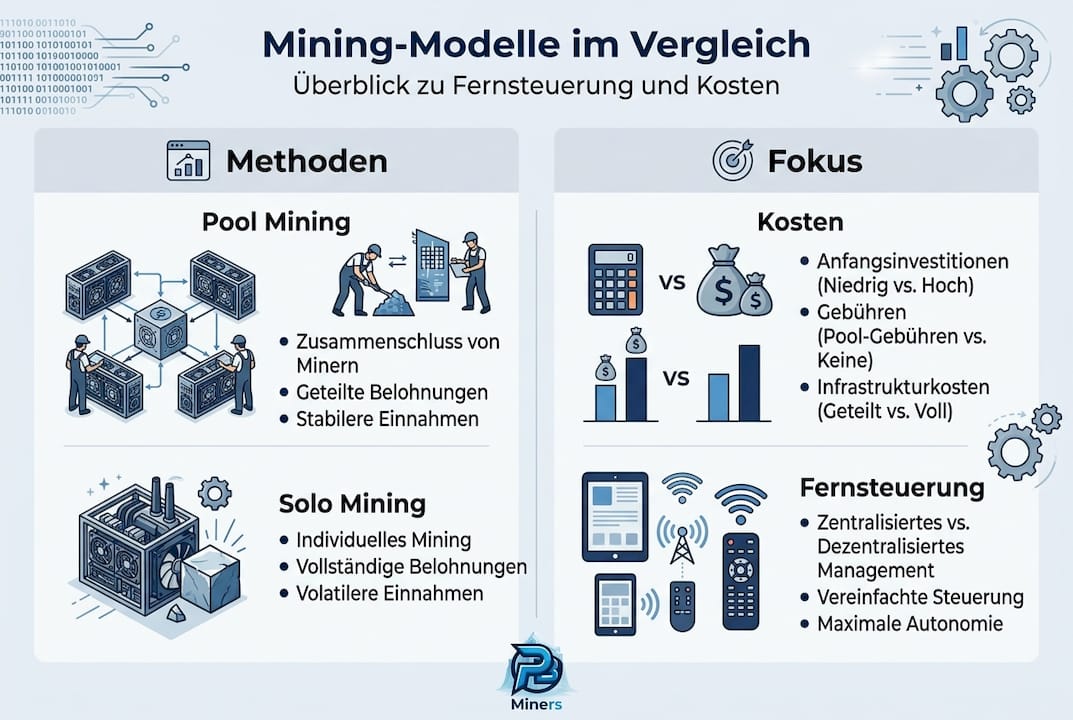
| Criterion | Pool Mining | Solo Mining | Home Mining with Remote Management |
|---|---|---|---|
| Payout | Regular, small | Rare, large | Rare, large, but controllable |
| Risk | Low | High | High, but reducible |
| Fees | 1 to 2.5% | None | None |
| Control | Low | Complete | Complete and monitored |
| Energy Optimization | Hardly possible | Manual | Automated via Remote Tool |
| Entry Barrier | Low | Medium | Medium to low with good hardware |
Pool mining offers small, reliable payouts, while solo mining carries high risks and potentially high rewards. For private users seeking financial independence, the risk of solo mining is calculable if the costs are right.
“Those who control their miner control their costs. Remote Management is not a luxury; it is the foundation for sustainable solo mining.”
The fee structure in pool mining initially sounds small. But 1 to 2.5% on each payout adds up significantly over months. With solo mining, you keep 100% of the block reward. Current mining trends show that more and more private users are choosing this path. If you want to delve deeper, the Understanding Solo Mining section provides a good introduction.
Practice: Effort, Costs, and Sustainability in Remote Mining Management
Theory is good. Practice is better. What does the concrete implementation look like?
Steps from setup to ongoing operation:
- Select and configure hardware: Device with pre-installed firmware and activated web interface
- Establish network connection: Integrate miner into home network, assign static IP address
- Set up remote access: Access via local network or VPN from outside
- Set up dashboard: Define thresholds for temperature, hashrate, and consumption
- Start test run: Monitor operation for 48 hours, evaluate logs
- Activate automation: Enable restart rules and alert notifications
The cost structure for a typical home miner with 15 to 21 watts of consumption looks like this:
| Cost Type | One-time | Monthly |
|---|---|---|
| Hardware (Bitaxe) | 150 to 300 Euros | 0 Euros |
| Power supply and accessories | 20 to 40 Euros | 0 Euros |
| Electricity costs (€0.30/kWh) | 0 Euros | approx. 3 to 5 Euros |
| Remote tool (Open Source) | 0 Euros | 0 Euros |
| Maintenance and spare parts | 0 Euros | approx. 1 to 2 Euros |
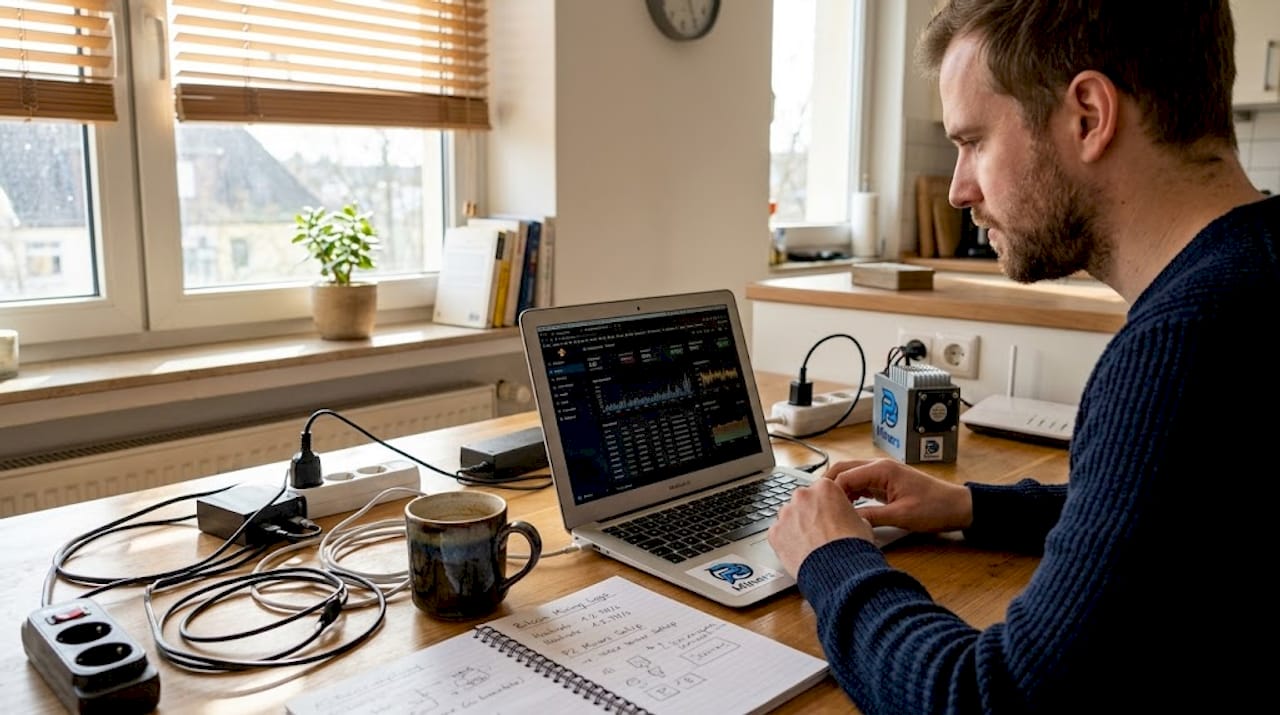
This shows that the ongoing effort is manageable. For those who want to recycle hardware sustainably and operate it long-term, specific recommendations can be found there.
An important data point: The break-even for new ASICs is approximately €0.045 to €0.055/kWh, which is significantly below German household electricity prices. This may initially sound disheartening. However, home mining with a Bitaxe is not a classic return on investment. It is a lottery ticket with real value that simultaneously strengthens the Bitcoin network.
Pro-Tip: Use a smart plug adapter with energy measurement. This way, you can see your miner's actual consumption in real-time, without relying on the dashboard. This is especially useful during initial setup.
What Most Overlook in Remote Mining Management: Practical Experience
Many beginners focus on hashrate. This is understandable, but short-sighted. The real challenge lies elsewhere.
First, electricity costs are chronically underestimated. Not just the miner itself, but the router, power supply, and other devices in continuous operation add up. If you only measure the miner, you only see part of the picture.
Second, simple control alone is not enough. A remote restart is useless if you don't know why the device crashed. Good logs and historical data are just as important as the control function itself. Anyone who wants to gain experience with independent control should rely on complete logging from the start.
Third, long-term efficiency is often ignored. Hardware ages. Fans get louder, chips become less efficient. Without historical data, you won't notice the gradual decline in performance. A good Remote Management system will show you this trend over weeks and months.
The honest lesson: Remote Mining Management is not a set-and-forget system. It is a tool that only fully realizes its potential if you read the data and react to it. Those who do so operate their solo miner more sustainably and with fewer unexpected costs.
How to Optimize Your Remote Mining with Polarblocks
If you want to implement Remote Mining Management seriously, you need hardware you can trust.
At Polarblocks, every Bitcoin Solo Miner is hand-assembled in Germany, delivered with pre-installed firmware and an activated web interface. No setup from scratch, no searching for drivers. The miner is immediately remote-capable. For more information on available Solo Miner Solutions, a complete overview of all models and bundles can be found there. For a stable power supply, we recommend the suitable power supply for mining, which is directly tailored to the requirements of the Bitaxe hardware. All devices come with a 30-day money-back guarantee.
Frequently Asked Questions about Remote Mining Management
What is Remote Mining Management?
Remote Mining Management refers to the remote control and monitoring of the mining process using digital tools to increase efficiency and security. Remote monitoring enables efficient mining, especially in solo mining, where downtime means direct costs.
At what electricity price is Bitcoin solo mining profitable in a home network?
Solo mining with new ASICs can only be traditionally profitable at electricity prices below €0.055/kWh, which is usually not achievable in German households. The break-even point is between €0.045 and €0.055/kWh, which is why home mining should be seen more as a lottery ticket than a classic investment model.
What are the advantages of remote mining management for private users?
It enables continuous control, early intervention in case of problems, and optimized energy costs for sustainable mining. Remote monitoring creates efficient solo mining without having to be physically present at all times.
What distinguishes pool mining from solo mining in terms of payouts?
Pool mining offers smaller but regular payouts with a fee of about 1 to 2.5%, while solo mining is riskier but potentially significantly more lucrative. Pool mining offers reliable payouts, while solo mining offers the chance for the full block reward, currently 3.125 BTC.
Recommendation
- Mining Performance Management: Efficiency & Sustainability 2026 – Polarblocks
- Independent Mining: More Control and Sustainability – Polarblocks
- Optimal Protection for Mining Hardware: Sustainability for Home – Polarblocks
- Mining Hardware Recycling: Sustainable & Efficient for Private Miners – Polarblocks


