

Decentralized Bitcoin Mining: Security and Independence
TL;DR:
- Five mining pools control up to 80% of Bitcoin's hashrate, threatening decentralization. High concentration enables attack scenarios like 51% attacks, censorship, or rule changes, compromising network security. Decentralized mining and running your own node strengthen network resilience and promote sustainable, independent engagement.
Five mining pools control up to 80% of the hashrate of the entire Bitcoin network. This single figure says more about the state of mining today than any price chart. Those who invest in Bitcoin because they value decentralization, censorship resistance, and financial self-determination should know exactly what this concentration means and how they can position themselves against it. This article shows you why hashrate concentration is a real risk, why decentralized mining means more than just technology, and how you, as a private user, can get started sustainably and independently.
Table of Contents
- Concentration in Bitcoin Mining: Risks and Facts
- Why Decentralization is Crucial for Mining
- Sustainable Investment Opportunities through Decentralized Mining
- Technical and Economic Challenges of Decentralized Mining
- Opinion: What Almost No One Considers in Decentralized Mining
- Your Entry into Decentralized Mining with Polarblocks
- Frequently Asked Questions
Key Takeaways
| Point | Details |
|---|---|
| Risk from Pool Concentration | Few mining pools control large portions of Bitcoin's hashrate and can jeopardize the network. |
| Decentralization Protects Against Censorship | Decentralized mining prevents manipulation and ensures a robust, secure blockchain system. |
| Sustainability as an Opportunity | With local surplus electricity, mining is environmentally sensible and offers independent investment models. |
| Note Technical Hurdles | New mining protocols exist, but adoption and usability are crucial for real progress. |
| Proactive Initiative is Key | Combining mining and node operation provides maximum control and security. |
Concentration in Bitcoin Mining: Risks and Facts
Bitcoin was designed as a distributed, permissionless network. No middleman, no central control. Today, the reality looks different.
The measurable hashrate concentration among a few mining pools shows a clear picture: whoever controls a large part of the computing power can delay transactions, theoretically double-spend them, or specifically censor certain transactions. This sounds abstract, but it is a mathematical fact of the network.
| Risk Scenario | Explanation | Entry Threshold |
|---|---|---|
| 51% Attack | Transactions can be reversed | From 51% hashrate |
| Censorship | Certain addresses are blocked | From 33% hashrate |
| Rule Changes | Protocol rules can be enforced by a majority | From 51% hashrate |
| MEV Extraction | Transaction order is manipulated | From 25% hashrate |
“If a few actors hold the majority of computing power, Bitcoin loses its strongest advantage: uncensorability.”
The danger is not only theoretical. In the past, the mining community has already seen how individual pools temporarily approached the 51% limit. Government interventions also play a role: a pool operating under the regulation of a country can be legally forced not to confirm certain transactions.
For investors, this means: the quality of your Bitcoin investment does not only depend on the price. It depends on the robustness of the network. And robustness suffers when the role of the community in decentralized mining shrinks.
What strengthens the network? More independent miners. More geographical distribution. More private users contributing their own hashrate.
Why Decentralization is Crucial for Mining
Decentralization is not an end in itself. It is the tool that makes Bitcoin resilient against attacks, prohibitions, and manipulation.

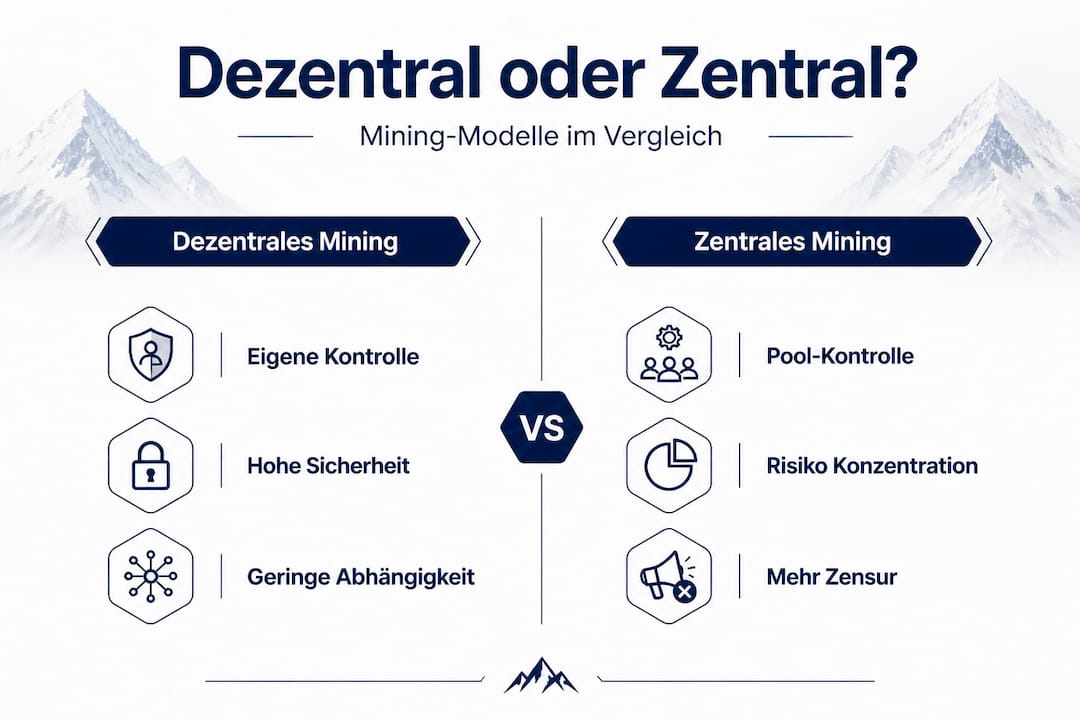
Decentralized mining significantly increases robustness against censorship and coordination risks. If thousands of miners work in different countries, on different devices, and without a common point of contact, there is simply no one who could be given a shutdown order.
| Feature | Decentralized Mining | Centralized Pool Mining |
|---|---|---|
| Control | Fully with the user | With the pool operator |
| Censorship Risk | Very low | High for regulated pools |
| Transparency | Fully traceable | Depends on the pool |
| Block Reward | 100% on hit | Divided, with fees |
| Network Contribution | Directly decentralizing | Concentrates power |
The concept of antifragility is crucial here. A system that gets stronger through stress is called antifragile. Bitcoin has repeatedly shown throughout its history that it does not collapse after hashrate losses, prohibitions, and attacks, but recovers and comes back stronger. The more distributed the miners, the more pronounced this characteristic.
For independent mining as a private user, this means concretely: you are not just an investor, you are a participant and protector of the network. Your miner votes with its hashrate on which version of the protocol is valid.
“Decentralization means that no single actor can hijack the network, because power is distributed among thousands.”
If you want to go a step further, you can also run your own full node. A node verifies each block itself and does not accept rule changes it doesn't approve of. That's secure mining hardware combined with true network sovereignty.
The most important advantages of decentralized solo mining at a glance:
- No third party decides on your transactions
- 100% of the block reward is yours if you find a block
- No pool account, no fees, no dependence
- You actively strengthen the decentralization of the network
- Plug & Play: Setup takes minutes, not days
Pro-Tip: Connect your miner to your own Bitcoin Node instead of a public pool server. This way, you validate blocks yourself and maximize your independence.
Sustainable Investment Opportunities through Decentralized Mining
Sustainability in mining means not only environmental friendliness, but also economic sense and long-term thinking.
Decentralized mining is particularly suitable for households with photovoltaic systems and surplus energy. The idea: electricity you generate yourself and do not feed into the grid is directly converted into Bitcoin hashrate. This is more efficient than feeding it in at low compensation rates.
How sustainable integration works step-by-step:
- Set up energy monitoring: Measure your actual PV surplus hourly. Apps and smart home systems can help.
- Configure miner: Set the miner to be active only when there is sufficient PV surplus. Many modern devices allow power regulation via API.
- Build automation: Tools like Home Assistant can automatically switch your miner on and off, depending on your system's energy status.
- Realistically calculate profitability: Honestly consider acquisition costs, electricity prices for night operation, and fluctuations in the Bitcoin price.
- Think long-term: Solo mining is not guaranteed income. It's a lottery ticket with real value and real chance.
Statistic: A modern Bitaxe miner consumes between 15 and 21 watts. This corresponds to the consumption of an LED light bulb. In full PV operation, there are virtually no electricity costs.
The sustainable mining trends show: more and more private users are combining renewable energies with solo mining. This reduces the ecological footprint and makes mining more economically attractive, even without a price surge.
Pro-Tip: Use an energy meter like a Shelly plug to track the actual consumption of your miner. Combined with a dashboard, you can immediately see when operation is worthwhile and when it is not. Mining efficiency can thus be optimized on a weekly basis.
Technical and Economic Challenges of Decentralized Mining
Decentralized mining sounds convincing in theory. In practice, there are hurdles you should be aware of.
The Stratum V2 protocol is considered an important advancement for greater decentralization in mining. It allows miners to select transactions for blocks themselves, instead of leaving it to the pool. This theoretically significantly reduces the risk of censorship. However: Technology and pool adoption are relevant, but decentralization also remains a question of market power and usability. Even if the protocol is available, many miners do not actively use the extended features.
The most common challenges in decentralized mining:
- Stratum compatibility: Not all miner firmwares support Stratum V2 with job negotiation. Check this before purchasing.
- Pool selection: Solo pools like ckPool or ocean.xyz differ significantly in fee structure and feature scope.
- Network latency: A miner located far from the nearest node loses time in block propagation. This minimally reduces effective hashrate.
- Usability trap: Many technical improvements fail because beginners do not configure them correctly. Good hardware with cleanly flashed firmware makes the difference here.
- Profitability without guarantee: The block reward is a chance, not a promise. Never plan with guaranteed income.
Mining hardware recycling is another aspect that many underestimate. Older devices can often still be used effectively if properly maintained and updated.
Pro-Tip: After every firmware update, check if all the features you use are still active. Especially with open-source firmware like AxeOS, updates can change the behavior of Stratum connections. A quick look at the dashboard after updates saves hours of debugging later.
Opinion: What Almost No One Considers in Decentralized Mining
Here's the uncomfortable truth: most people talking about decentralized mining talk about hardware. About hashrate. About electricity. But rarely about what truly matters.
True decentralization only emerges from the interplay of mining and one's own node. A miner dependent on an external server delegates part of their sovereignty. A miner working with their own full node validates themselves and votes themselves. That's the difference between participating and having a say.
Decentralization must be viewed in the overall context: mining and nodes together create a system that remains resilient even if individual parts fail. Bottlenecks don't mean the end, but a temporary obstacle for an antifragile network.
What this means for you: Don't just buy a miner and forget about it. Understand why you're mining. Understand how you gain even more control with a node. And understand that your contribution, however small, truly matters. Not because we romanticize it, but because that's how the network's mathematics see it.
Also check out Mining Security in the Home Office to properly secure your operation from the start. Security is not an optional extra; it is the core of the entire endeavor.
Your Entry into Decentralized Mining with Polarblocks
At Polarblocks, we built our Bitcoin Solo Miners precisely for this purpose: quiet, efficient, pre-configured. No programming knowledge needed, no hours of setup. Every miner leaves our workshop in Bavaria flashed, tested, and stress-tested. You plug it in, it runs, and every 10 minutes you have a new chance at 3.125 BTC. Check out our Solo Mining product page and find the setup that suits your situation, whether you want to use PV surplus or just start at your desk. We answer every question personally.
Frequently Asked Questions
Is decentralized mining really safer than centralized mining?
Decentralized mining significantly increases robustness against censorship and coordination risks, as no single entity alone controls the hashrate. Solo miners are not dependent on pool decisions or external regulations.
How can I use my PV surplus for mining?
PV surplus can be automatically routed to your miner by only using surplus electricity and controlling the miner via smart home automation. This ideally results in almost no additional electricity costs.
Which technical challenge is particularly relevant in decentralized mining?
Even if Stratum V2 is available, the actual adoption of new features often falls short of expectations because not all miners and pools fully implement the extended functions. Therefore, before purchasing, check which features your hardware actually supports.
What happens if mining is threatened by centralization?
The Bitcoin network is considered antifragile and quickly recovers after hashrate losses due to bans or changes in country. The difficulty automatically adjusts, allowing the network to continue operating even with less hashrate.


