

The Truth About Passive Income 2026
In a Nutshell
The dream is tempting: earning money while you sleep. But the sober reality of 2026 shows that genuine passive income streams require either massive starting capital, consistent planning, or both. Those who ignore this quickly fall victim to dubious social media promises, which often lead to total loss. We deconstruct common myths about interest and dividends and show why the radical step into physical self-sufficiency – such as highly efficient Solo Mining at one's own desk – is gaining new relevance for private users in German-speaking countries.
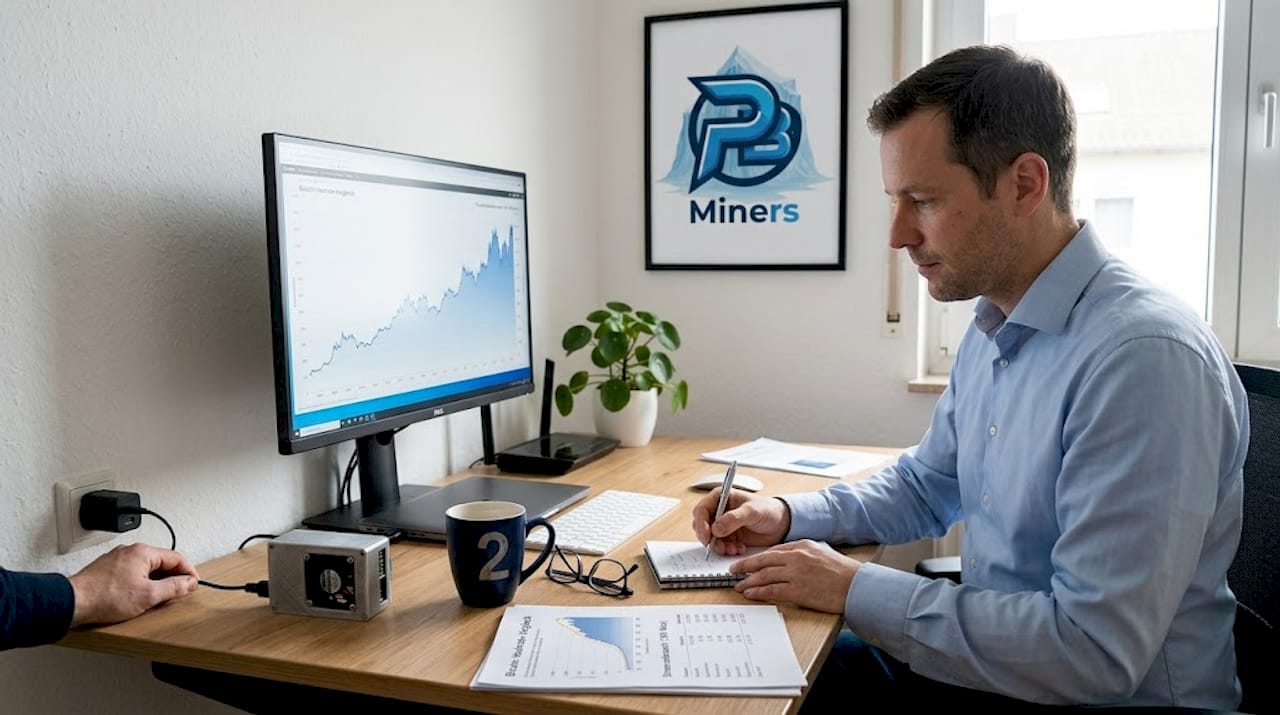
The image is ubiquitous on social media: influencers relaxing by the pool, laptop closed, and the account seemingly filling itself. What is conveniently omitted is the immense lead-time that precedes this state. Whether rental income, stock dividends, or digital products – each of these classic paths requires an extreme amount of time, considerable capital, or both in the initial phase. Passive income without any effort is a dangerous myth for the average private user. Anyone who promises guaranteed high returns without any risk is simply not telling the truth.
Table of Contents
The Hard Calculation: The Truth About Dividends
Numerous investors dream of a monthly additional income of 1,000 euros, financed purely from dividends. However, the mathematical reality behind this is sobering: with an average dividend yield of 2.5 percent, you need approximately one million euros in tied-up capital to achieve this goal. Even if this sum were available, real inflation quietly erodes returns. For example, anyone receiving 3 percent interest on their overnight deposit account today, but also having to endure an inflation rate of 3.5 percent, is effectively losing purchasing power every day. A realistic income plan therefore always begins with defining the net target, reverse-calculating the required capital after taxes, and ruthlessly considering monetary depreciation.
Asset Classes in 2026 in Direct Comparison
To make informed decisions, we must rigorously examine the common models for generating passive income streams. In doing so, we look not only at the expected returns but, above all, at the often-concealed entry barriers and the level of personal independence.
| Asset Class | Entry Barrier | Autonomy Level | Expected Annual Return |
|---|---|---|---|
| Real Estate | Very High (from €100,000) | Medium | 3 to 5 % net |
| ETF Portfolio | Medium (from €10,000) | Low | 5 to 8 % |
| Hardware Mining (Solo) | Low (from €200) | Very High | Asymmetric |
Lottery Mining: The Unconventional Trend in 2026
In a market environment where traditional returns are being eaten away by inflation, an approach is coming into focus that initially seems unusual but follows brilliant mathematical logic. In so-called lottery mining, known in specialist circles as solo mining, a single user mines directly on the Bitcoin network with their own hardware, completely without the involvement of large mining pools. The statistical probability of finding a block may be low, but it is a real possibility. The decisive lever: if the device finds a block, 100 percent of the complete 3.125 BTC belongs to the operator, without any deductions.
Electricity Costs as the Only Raw Material
The profitability of this model stands and falls with energy efficiency. The days of roaring, power-hungry server farms in the basement are over. The technological avant-garde in 2026 relies on whisper-quiet desktop miners. A state-of-the-art device like the Bitaxe Gamma 601 consumes only about 15 watts in continuous operation – equivalent to the power consumption of a simple LED light bulb. Anyone who also has a private photovoltaic system or access to renewable energy surpluses operates this asymmetric bet on financial freedom almost cost-neutrally.
Red Flags: How to Spot Financial Scams Immediately
The search for returns drives many investors into the arms of fraudsters. The consumer protection agency explicitly warns against investment offers on social media, which often end in disastrous total loss. Anyone confronted with guaranteed profits, exclusive insider tips, or massive time pressure through countdown timers in the crypto sector should immediately distance themselves. Promises of so-called APY (Annual Percentage Yield) returns over 12 percent in crypto staking are particularly critical. If platforms do not comply with clear imprint requirements, are not regulated by European authorities, and cannot provide a comprehensible explanation for such astronomical interest rates, they are usually highly toxic scams. True security requires absolute transparency and, ideally, bypassing intermediaries through the use of one's own physical hardware.
Conclusion: The Path to True Autarky
The uncomfortable truth of the financial world is: passive income is almost always the hard-earned result of active development. Those who mechanically plan and take seriously the levers such as electricity costs, tax burden, and hardware efficiency are far better positioned than the majority of investors. Your own solo miner is not a magic bullet, but an extremely honest tool. You know your investment, you know your minimal power consumption, and you hold a fair, asymmetric chance in your own hands, without having to rely on dubious cloud providers.
Your Entry into Solo Mining
Secure your chance for the full block reward, completely self-sufficient and secure from home. The Bitaxe Gamma 601 is hand-assembled, tested, and delivered fully configured in Bavaria. Plug & Play, literally.
Get the Bitaxe Gamma nowFrequently Asked Questions (FAQ)
How much capital do I need for €1,000 in monthly passive income from dividends?
With an average dividend yield of 2.5 percent, you need approximately 1 million euros in capital to generate 1,000 euros net monthly. In addition, the creeping erosion of money due to inflation must be taken into account, which further weakens this real value approach.
Is passive income truly risk-free in 2026?
Real passive income is practically never completely risk-free. Especially in the area of unregulated crypto products and aggressive social media offers, there are considerable risks of fraud. Consumer protection agencies regularly warn of the concrete danger of a total loss in this regard.
What factors determine the profitability of Bitcoin mining?
A thorough analysis shows that local electricity costs, the efficiency of the hardware used (measured in watts per terahash), network difficulty, and the current Bitcoin price are the key factors for profitable operation. Those who rely on extremely energy-efficient hardware significantly minimize their ongoing risk.
Further Analyses for Smart Investors
Anyone who wants to better understand the risks in the digital asset class should definitely study our comprehensive guide Solo Mining: Safe or Scam? Facts, Risks Explained. To meticulously calculate your own electricity costs, we recommend using our in-house Peace of Mind Solo Cost Calculator. The hard facts about the absolute scarcity of the network can be found in the detailed analysis How many Bitcoins really exist?.


