

The Central Role of the Community in Bitcoin Mining 2026
Over 95 percent of Bitcoin's hashrate is controlled by only six large mining pools. This number sounds concerning and contradicts Bitcoin's decentralized vision. However, the community has long developed effective mechanisms to combat this concentration. Private miners play a crucial role in this. They actively switch between pools, use open-source hardware, and rely on sustainable energy sources. This article shows how the mining community functions in 2026 and why it is more important than ever.
Table of Contents
- Preventing Centralization through Pool Switching and Solo Mining
- Sustainability and Ecology: Community Mining with Renewable Energies
- Technological Innovations and Democratization through Open-Source Hardware
- Help with Frequently Asked Questions about the Community's Role in Bitcoin Mining
Key Insights
| Point | Details |
|---|---|
| Mining Pools Democratize Access | Smaller miners receive proportional rewards through pools and can participate in mining efficiently. |
| Pool Switching Prevents Centralization | Community miners actively switch pools to reduce power concentration and increase network security. |
| Sustainable Energy Reduces Costs | Coordinated use of renewable energy can reduce mining costs by up to 46 percent. |
| Open-Source Hardware Promotes Democratization | Open technologies lower entry barriers and enable innovation through collaborative development. |
| Stratum V2 Improves Security | The new protocol gives individual miners more control and significantly reduces centralization risks. |
How the Community Democratizes Bitcoin Mining through Mining Pools
Mining pools are the backbone of the modern Bitcoin community. They operate on a simple principle: many individual miners combine their computing power to find blocks together. Rewards are distributed proportionally to the contributed hashrate, allowing even smaller participants to receive regular payouts. Without pools, private miners would stand no chance against industrial farms.
The functionality is transparent and fair. Each miner contributes their computing power and receives a share of the found block according to their participation. This makes mining predictable. Instead of waiting years for a lucky strike, pool members receive steady, albeit smaller, returns. This predictability significantly reduces financial risk.
The community benefits in several ways from this model. Firstly, it allows less technically savvy users to get started. Secondly, it promotes geographical diversity, as miners worldwide can participate. Thirdly, it creates incentives for hardware innovation, such as the Premium Bitaxe Miners, which are specifically optimized for home use.
Pro Tip: Don't just choose your pool based on fees. Pay attention to decentralization factors such as geographical distribution, operator transparency, and support for Stratum V2. Smaller pools with fair conditions strengthen network security more than the largest providers.
The most important advantages of mining pools:
- Regular, predictable payouts instead of years of waiting
- Low entry barriers for private miners with limited hardware
- Shared cost distribution for infrastructure and maintenance
- Access to professional mining software and technical support
- Opportunity to experiment without significant financial risk
Democratization through pools has fundamentally changed the mining ecosystem. Previously, a few large players with multi-million dollar budgets dominated. Today, anyone with modest hardware can participate. This development strengthens Bitcoin's decentralized vision and makes the network more resilient to attacks.
Preventing Centralization through Pool Switching and Solo Mining
The concentration of hashrate is real and concerning. Six pools control over 95 percent of the blocks found, with Foundry alone holding about 30 percent. This concentration poses theoretical risks for 51 percent attacks. However, the community has developed effective countermeasures.
Pool switching is the most important tool against centralization. Miners can transfer their hashrate from one pool to another at any time. This mechanism functions like a market: pools that behave unethically or become too dominant quickly lose members. The community actively uses this flexibility to prevent power concentration. Economic incentives and competition among pools protect the network more effectively than any central regulation.
Solo mining is experiencing a renaissance in 2026. Technical advancements and more efficient hardware are making it attractive again. With solo mining, the miner keeps the entire block reward but also bears the full risk. This method maximizes decentralization, as no intermediaries are involved.
| Aspect | Pool Mining | Solo Mining |
|---|---|---|
| Payout Frequency | Regular, predictable | Rare, but complete |
| Entry Barrier | Low, suitable for all | Low |
| Decentralization Effect | Medium, depending on the pool | Maximum, completely independent |
| Technical Complexity | Low, pool handles setup | Low, Plug & Play |
| Cost Efficiency | Good with small hashrate | Better with larger hashrate |
Important strategies against centralization:
- Active switching to smaller, transparent pools in case of power concentration
- Support for pools that promote Stratum V2 and decentralized practices
- Operating own nodes for solo mining with sufficient hashrate
- Geographical diversification by choosing internationally distributed pools
- Public discussion and community pressure in case of problematic pool behavior
The community has proven that it can actively combat centralization. Historical examples show: as soon as a pool became too dominant, miners left it en masse. This self-regulation works better than government intervention.
Sustainability and Ecology: Community Mining with Renewable Energies
Energy is the biggest cost factor in mining. The community has realized that the coordinated use of renewable energies can reduce costs by up to 46 percent. This insight fundamentally changes the mining ecosystem. Sustainability is no longer just idealism, but economically viable.
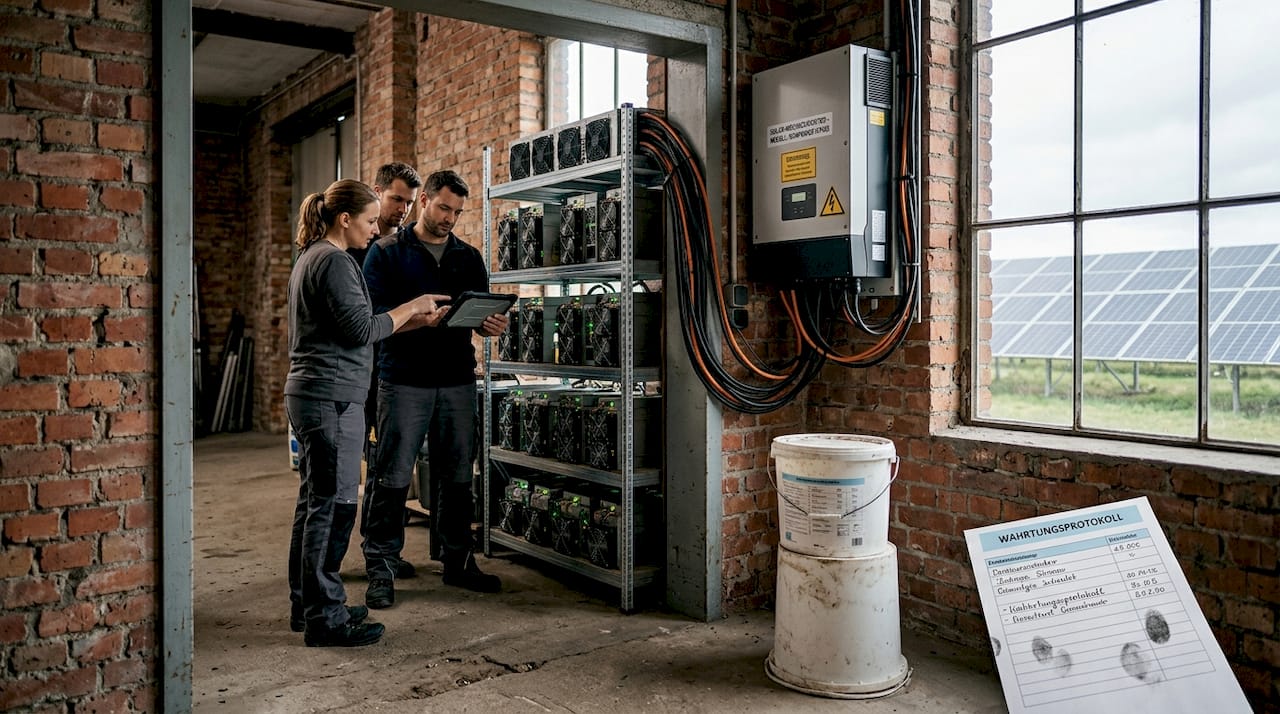
Solar and wind energy offer perfect synergies with mining. Surplus energy from renewable sources can flow directly into mining hardware instead of being wasted. The community is increasingly organizing itself around these resources. Miners in sunny regions operate their hardware during the day, while wind energy users are active at night.
Bitaxe hardware plays a key role in sustainable mining. These devices consume significantly less energy than industrial ASICs and are ideal for operation with limited renewable sources. The Low Profile Plus Bitaxe Cooler further optimizes efficiency through improved cooling with minimal energy consumption.
Community coordination amplifies these effects. Mining communities share information about energy prices, peak loads, and optimal operating times. This transparency allows individual miners to operate their hardware when energy is cheapest and cleanest. The result: lower costs and a smaller ecological footprint.
The combination of renewable energies and efficient hardware can improve the economic viability of solar installations by over 60 percent by monetizing surplus energy.
How to organize sustainable mining communities:
- Identify local sources of renewable energy with overcapacities or favorable tariffs
- Form networks with other miners in your region for information exchange
- Invest in energy-efficient hardware such as Bitaxe models with optimized cooling systems
- Use intelligent control systems that automatically start mining when electricity prices are low
- Document and share your results to inspire other community members
- Cooperate with local energy providers for special mining tariffs during peak loads
Pro Tip: Many energy providers pay for load balancing. Miners can offer their hardware as a flexible load and receive compensation for shutting down during network overload. These dual revenues significantly improve economic viability.
The ecological responsibility of the community goes beyond energy sources. Durable hardware, repairability, and recycling are becoming increasingly important. Manufacturers like PolarBlock Labs focus on high-quality components and modular designs that allow upgrades instead of complete replacements.
Technological Innovations and Democratization through Open-Source Hardware
Open-source hardware fundamentally changes the mining landscape. Proprietary systems from large manufacturers no longer dominate alone. The community develops its own solutions, shares designs, and jointly improves the technology. This movement lowers entry barriers and promotes innovation at a pace that commercial providers cannot match.
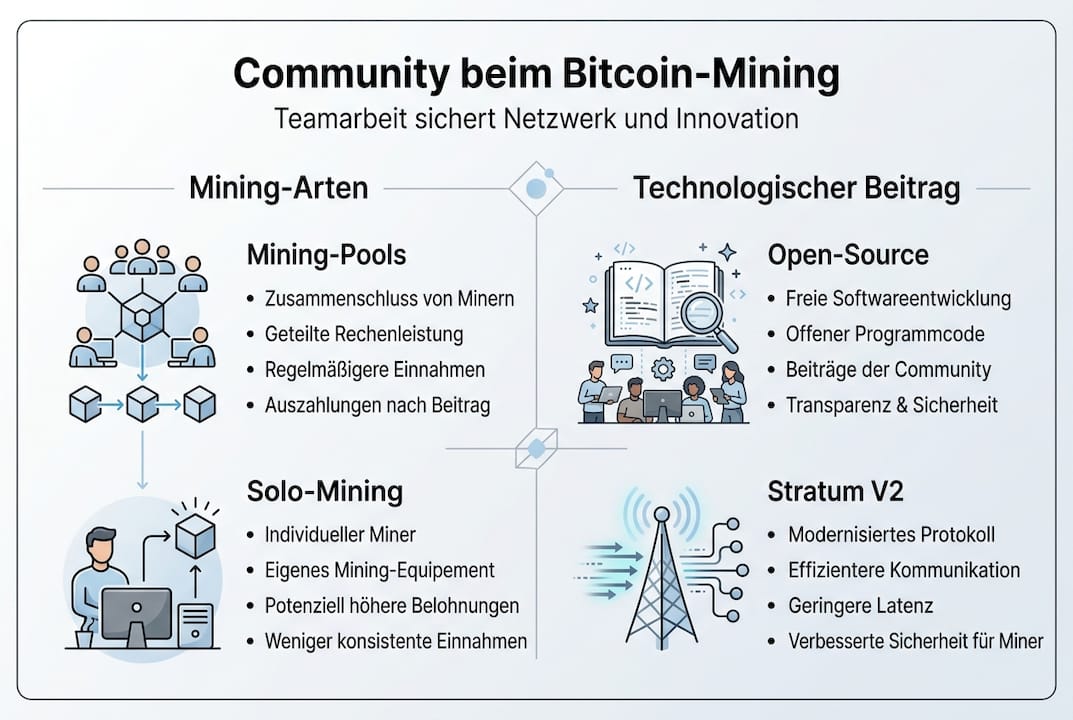
The Stratum V2 protocol is a prime example of community-driven innovation. Empirical data shows that over 50 percent of the hashrate is concentrated in pools, but the interchangeability of miners and V2 significantly mitigate these risks. The protocol returns control over transaction selection to individual miners, even within large pools.
The Bitaxe platform perfectly embodies the open-source idea. All designs, schematics, and software are freely available. The community can develop its own variants, propose improvements, and contribute to further development. This openness accelerates innovation and prevents monopolization.
3D prints for Bitaxe show how far democratization can go. Users can produce, customize, and improve housings and cooling components themselves. Designs are shared within the community so that everyone benefits from the best solutions. This decentralization of production was unthinkable a few years ago.
Advantages of open technologies in mining:
- Transparency in hardware design enables independent security checks
- Lower costs through collaborative development instead of proprietary research
- Faster innovation through parallel work of many developers worldwide
- Adaptability to specific needs and local conditions
- Formation of a strong community with shared knowledge and support
- Independence from individual manufacturers and their business decisions
Technological democratization has practical implications. Previously, tens of thousands of euros were needed for competitive mining hardware. Today, open-source designs allow entry with hundreds of euros. This accessibility strengthens Bitcoin's decentralized vision and makes the network more resilient.
Pro Tip: Get involved in open-source projects, even if you are not a developer. Test new designs, provide feedback, and share your experiences. The community thrives on active participation, and every contribution counts.
The combination of open-source hardware and modern protocols like Stratum V2 creates a robust ecosystem. Individual miners have more control, pools can abuse less power, and innovation happens faster. This development is crucial for the long-term health of the Bitcoin network.
Future technologies such as improved ASICs with even lower energy consumption or AI-optimized mining strategies will also be driven by the community. Open development ensures that these advances benefit everyone, not just large corporations.
Discover Sustainable and Efficient Mining Hardware at PolarBlocks
Now that you understand the importance of community and sustainable technologies, the next step is choosing the right hardware. PolarBlock Labs offers specially optimized solutions for private miners who value efficiency, sustainability, and decentralization.
The NMminer TV 1 MH/s Miner combines impressive performance with extremely quiet operation. This hardware is perfect for home use and supports the decentralized mining community. The handcrafted quality and German manufacturing guarantee durability and reliability.
For optimal cooling performance, the Low Profile Plus Bitaxe Cooler is recommended. It significantly lowers operating temperature and extends the lifespan of your hardware. The combination of efficient cooling and low energy consumption makes sustainable mining at home possible.
The matching 5V 30W 6A power supply completes the setup. Stable power supply is crucial for reliable operation and optimal performance. PolarBlock Labs offers coordinated components that together achieve maximum efficiency.
Help with Frequently Asked Questions about the Community's Role in Bitcoin Mining
What are the advantages of sustainable mining with renewable energies?
Coordinated use of renewable energies can reduce mining costs by up to 46 percent. Surplus solar or wind energy is used productively instead of wasted. The economic viability of renewable installations improves by over 60 percent through mining as a flexible load.
How does open-source hardware help private miners?
Open-source designs significantly lower entry barriers and allow customization to specific needs. The community can collaboratively develop and share improvements. Transparency in hardware design enables independent security checks and prevents monopolization by individual manufacturers.


