

Hardware Sovereignty 2026: Desktop Miners as a Stock Market Alternative
EXECUTIVE SUMMARY: More and more private investors are losing trust in centralized crypto platforms and are relying on their own hardware. This so-called hardware sovereignty protects investors from insolvency damages à la FTX and enables independent validation within the Bitcoin network. Through whisper-quiet, highly efficient desk miners that mine directly to one's own cold wallet, the risky platform model is replaced by autonomous, private crypto asset management.
Anyone who still remembers the headlines surrounding the FTX collapse or the Mt.Gox scandal immediately understands why the financial elite in German-speaking countries are asking a radical question: Why use a centralized exchange at all anymore? The trend towards proprietary mining hardware has long since left the hobby niche and established itself as a macroeconomic response to a fragile system. Anyone who operates their own desk miner no longer delegates responsibility. They hold the real cryptographic keys, direct computing power to the network without an intermediary, and become completely independent of platforms that could file for bankruptcy tomorrow.
Why is hardware sovereignty the only protection against crypto insolvencies?
Hardware sovereignty means absolute and uncompromising control over the validation process and the custody of digital assets, thereby mathematically eliminating the risk of total loss due to exchange bankruptcies. The principle "Not your keys, not your coins" has transformed from a cypherpunk motto into a harsh financial-mathematical reality. Even official regulatory authorities like the BaFin regularly warn against the enormous custody risks associated with centralized crypto platforms, as users in the event of insolvency are often legally only unsecured creditors and not owners of their deposits.
The antithesis to this black box is one's own infrastructure at home. Those who choose this path completely eliminate counterparty risk. The hardware provides direct access to the network, blocks regulatory overreach, and protects privacy without excessive KYC (Know Your Customer) processes. It is the shift from a supplicant system to true, digital ownership.
How does solo mining work without centralized crypto exchanges?
Through decentralized protocols like Solo.ckpool, private users send their cryptographic computations directly to the Bitcoin network, with any block rewards, currently 3.125 BTC, flowing immediately to an encrypted cold wallet without deductions or intermediaries. Modern desk miners like the Bitaxe Gamma Snowstorm from Polarblock Labs make this independence physically tangible. These devices are based on highly efficient ASIC chips, operate almost silently, and consume only 15 watts of power, similar to a standard LED lamp.
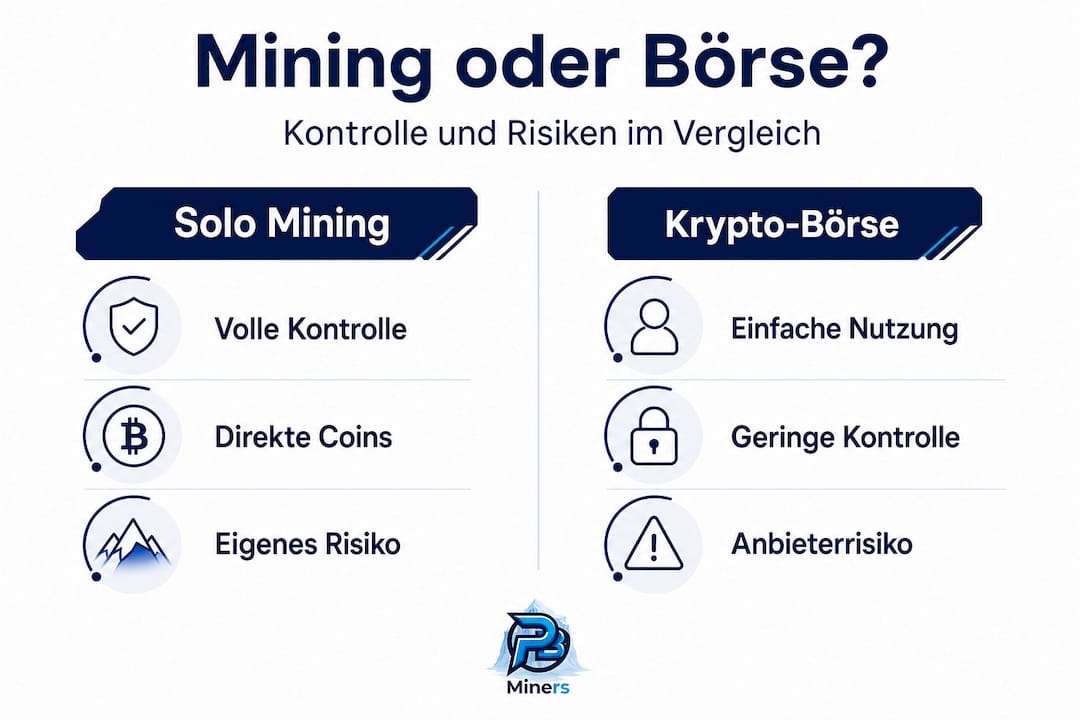
| Criterion | Home Solo Mining | Centralized Crypto Exchange |
|---|---|---|
| Control over Assets | Complete Hardware Sovereignty | None (High Custody Risk) |
| Counterparty Risk | Non-existent | Extremely high (Platform Insolvency) |
| Privacy & Data | Maximum Anonymity | Mandatory KYC & Data Leaks |
| Objective | Network Security & Lottery Chance | Speculative Day Trading |
The economic operation of these micro-miners requires a strategic approach to energy costs. Market analysts emphasize that using photovoltaic surpluses – for example, through modern balcony power plants – drastically reduces operational expenses (OPEX). Those who intelligently use their miner as a load sink for otherwise produced solar power transform a physical inefficiency into a digital yield opportunity, without burdening the electricity bill.
What infrastructure does a private node really need?
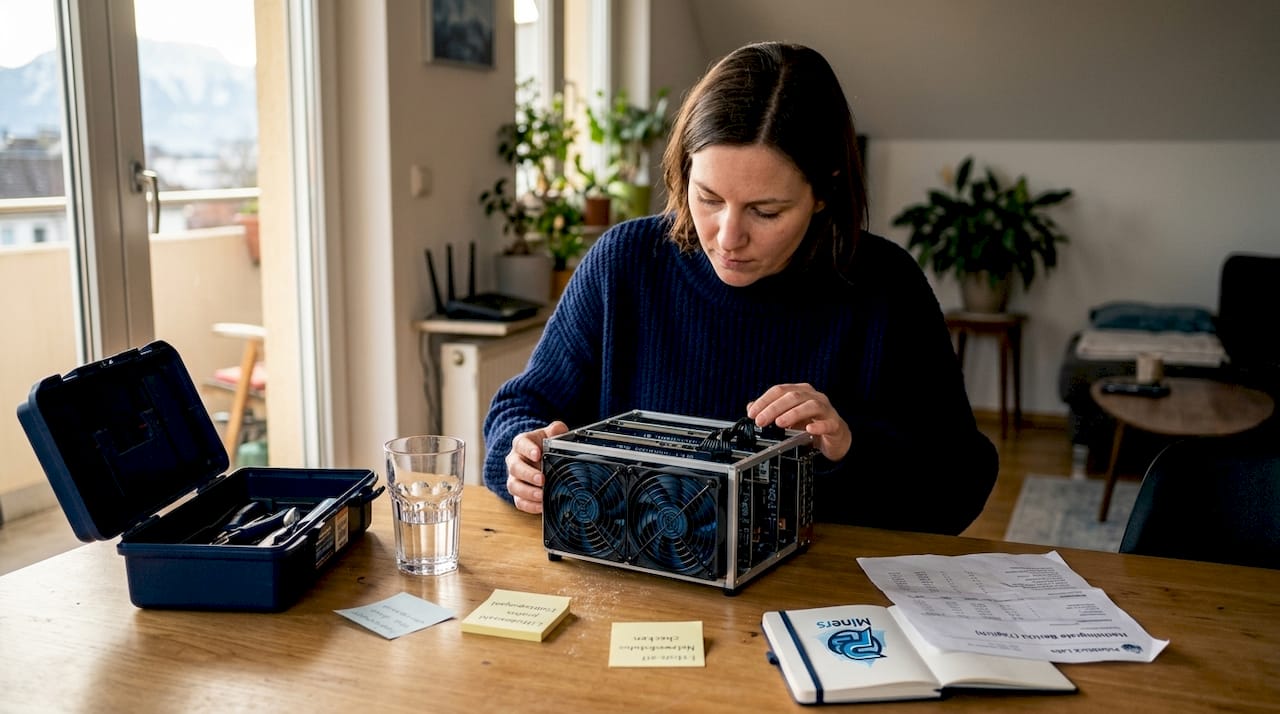
An autonomous node no longer requires expensive server racks, but merely an efficient ASIC miner combined with a storage-optimized "pruned" node, which compresses data requirements to under 100 gigabytes. While a classic full node stores the entire blockchain history, which is over 600 GB, a pruned node restricts itself to the data essential for immediate validation. It verifies each new block with exactly the same cryptographic rigor, but deletes old historical data to save storage space.
This technical efficiency significantly lowers the barrier to entry for private investors. A standard laptop or a decommissioned mini-PC with 128 GB of storage is entirely sufficient to lay the foundation for one's own financial sovereignty. In combination with a premium desktop miner, a closed, highly secure ecosystem is created directly on the desk.
Why do mainstream guides fail to grasp the reality of mining?
Classic financial advisors incorrectly evaluate solo mining solely on its guaranteed Return on Investment (ROI) and completely ignore the value of systemic independence. The "solo mining vs. exchange" analysis is usually misguided. It's not about short-term yield optimization through day trading, but about owning a crisis-proof asset that doesn't depend on the balance sheets of a dubious exchange CEO.
Furthermore, superficial guides overlook the importance of ergonomics and hardware quality in the home office. An unstable hashrate due to inferior cooling or extremely loud fans destroys both profitability and comfort. Only hardware designed for continuous operation in living spaces delivers the strategic added value that modern investors seek.
How to start building your own infrastructure?
The transition from a crypto exchange to your own hardware sovereignty begins with selecting the right equipment. Polarblock Labs positions itself as a global pioneer for premium home mining. The Bitaxe Gamma Snowstorm delivers exactly the parameters required for a successful and undisturbed solo mining setup in the office: it is thermodynamically optimized, whisper-quiet, and rigorously tested according to European quality standards.
Say goodbye to centralized risks and take control of your digital assets. Use decentralization not just as a buzzword, but as a physical device on your desk.
Recommended Analyses
Hardware as the New Gold: Security through Sustainable Mining – Polarblocks
Platform Risks: Solo Mining Security vs. Exchange Fraud – Polarblocks
Tax Aspects of Hardware Sovereignty 2026 – Polarblocks
The FTX Trauma & The Return of "Nodes"
Why do people put a small, rotating cube on their desk when they could just buy crypto via an app? Because they've learned from pain.
The multi-billion dollar crash of the FTX exchange and the demise of platforms like Celsius have hammered a brutally simple crypto rule back into people's minds: "Not your keys, not your coins." If you leave your digital assets on a platform, they're not yours. You merely have an unsecured claim against a company. And if the CEO messes up, you're left facing locked servers.
Solo mining is the radical counter-proposal. It is the purest form of financial sovereignty. When the Bitaxe Gamma searches for blocks via a decentralized service provider (like Solo.ckpool), there are no intermediate accounts. If the device finds a block, the reward of 3.125 Bitcoin lands directly in your encrypted cold wallet, without detours, without KYC registration (Know Your Customer), and without an intermediary. It is pure, censorship-resistant ownership.
The elite of home miners goes one step further and combines the solo setup with a so-called "Pruned Node". Instead of blindly trusting a foreign server, they install the Bitcoin network on an old, recycled laptop. Due to "pruning", this node requires less than 100 GB of storage. It verifies transactions completely autonomously. This is no longer speculation; this is the operation of your own incorruptible central bank on the shelf.
The "Energy Arbitrage" (Hack the Power Grid)
Most beginners ask us the wrong question at the Polarblock workshop. They ask: "Is it worth it with 30 cents electricity costs?"
The correct answer is: Anyone who stubbornly operates their miner at 30 cents per kWh has not understood the system. The magic word for 2026 is Energy Arbitrage.
Remember the Bitaxe's 15 watts? This extremely low power consumption is its greatest weapon. Do you have a small 600-watt balcony power plant (PV system)? At noon, the thing pumps electricity into the house that you can't even completely use. Instead of giving this surplus electricity to the municipal utilities unremunerated, you route it into your desk miner. Your miner transforms this physical inefficiency into cryptographic hashrate. Your effective operating costs (OPEX) in this scenario drop to exactly zero euros.
Or you use dynamic electricity tariffs (like Tibber). On sunny, windy Sundays, the spot price on the Leipzig power exchange often falls into negative territory. The open-source firmware of the Bitaxe (AxeOS) can be controlled via APIs so that the miner starts up exactly when electricity is cheap. This is intelligent load shedding (load-dumping), as practiced in industry, just compressed for your desk.
⚡ The "Load Sink Matrix": Calculate your Setup
While the masses speculate on the Bitcoin price, smart miners calculate in watt-hours. Which case study fits your setup?
You're in the office, the sun is shining. Your 800W inverter pushes surplus into the house. The Bitaxe (15W) runs 100% autonomously via solar.
Result: 0.00 Euro running costs. Pure lottery chance at no cost.
Coupled with Home Assistant, the Bitaxe starts automatically when the spot market price drops below 10 cents/kWh (e.g., at night with strong winds).
Result: Extremely cheap hashrate, asymmetrical risk minimized.
You operate the "NerdQAxe" (approx. 90 watts) continuously in winter. The waste heat is warmth. Every euro you put into the miner heats your office with 90 watts. The heating stays off.
Result: Thermodynamic mining. The computing power is a byproduct of heat generation.
Right to Repair: Buy Your Sovereignty
The era of black box devices is over. Polarblock Labs stands for a deep conviction: hardware you can't repair, you don't own. The Bitaxe Gamma and the larger NerdQAxe are completely open source. This means: every blueprint, every circuit board, every line of code is open. If the fan breaks in five years, you don't buy a new device. You buy a standard Noctua fan, grab a screwdriver, and replace it yourself.
This is true decentralization. It's not just about software. It's about hardware that's in your hands, purring quietly on your desk, and letting you participate in the greatest financial revolution of our time.
Explore the Bitaxe Collection and start your own revolution →


