

Mining Hardware Recycling: Sustainable & Efficient for Private Miners
TL;DR:
- Legal regulations require the environmentally sound return of mining hardware in Germany.
- Professional recycling includes dismantling, precious metal recovery, and documentation for environmental and legal certainty.
- Refurbishment of hardware is more resource-efficient and economical than immediate recycling.
Somewhere in your basement or office, there might be an old ASIC miner that hasn't seen a block in months. It's gathering dust, no longer consuming power, but its ecological footprint still exists as long as it's not disposed of properly. 1.5 tons of CO2 can be saved per ton of recycled e-waste, and that's precisely where you, as a private miner, have leverage. A structured recycling workflow not only protects the environment but also creates real value, ensures your data security, and keeps you on the right side of German law. This article will guide you step by step through the entire process.
Table of Contents
- Legal Requirements and Environmental Goals for Hardware Recycling
- Preparation: What to do before recycling?
- Main Step: Recycling Workflow in Detail
- Completion and Control: Results, Environmental Benefits, and Documentation
- Our Assessment: Why Refurbishment is the Real Game Changer
- Next Steps: Sustainable Mining with Modern Hardware
- Frequently Asked Questions
Key Insights
| Point | Details |
|---|---|
| Legally Compliant Disposal | Mining hardware must be properly recycled or reused in accordance with ElektroG and WEEE to avoid fines. |
| Data Deletion Protects Privacy | A complete reset and secure data deletion are the most important first step before any re- or onward transfer. |
| Always Prioritize Refurbishment | Refurbishment saves CO2, raw materials, and protects both wallets and the environment – recycling is a second choice. |
| Measurably Improve Sustainability | The proper workflow saves up to 1.5t of CO2 per ton of recycled e-waste and directly contributes to climate protection. |
Legal Requirements and Environmental Goals for Hardware Recycling
Many private miners underestimate what legally applies when a device has reached the end of its life. In Germany, the matter is clearly regulated: Mining hardware falls under the ElektroG, the German implementation law of the European WEEE directive, and must be recycled accordingly. This applies not only to companies but also to private individuals. The recovery targets are between 75 and 85 percent of the material weight, depending on the device category.
Mining hardware, meaning ASICs, GPUs, and associated power supplies, typically falls into the category of "Information and Telecommunication Equipment" under ElektroG. This means you cannot simply dispose of these devices in household waste. Municipal recycling centers accept electronic waste free of charge, but for valuable mining hardware, there are much better options.
Overview of important device categories:
- ASICs (e.g., Antminer, Whatsminer): IT devices category, high precious metal content
- GPUs (graphics cards): IT peripherals category, particularly valuable
- Power supplies and cables: Household large appliances or IT category, depending on wattage
- Cooling systems and casings: Metal scrap or IT category, depending on design
| Device Category | ElektroG Category | Recovery Target |
|---|---|---|
| ASIC Miners | IT Devices | 80 % |
| GPU Cards | IT Peripherals | 75 % |
| Power Supplies | IT Accessories | 75 % |
| Heatsinks/Casings | Metal Scrap | 85 % |
For private miners who want to dispose of their devices professionally and legally compliant, certified providers such as K&P, afb, and ReUsed-IT offer specialized services. These companies handle the entire logistics, issue disposal certificates, and ensure that your hardware is correctly returned to the material cycle.
Pro-Tip: Those who hand in their hardware via certified purchase platforms often receive remuneration for functional components. This is economically more sensible than going to the recycling center and still complies with all environmental standards for mining.
By the way, complying with the legal requirements for Bitaxe and other home devices is easier than you might think if you work with a certified partner. They will handle the documentation and provide you with all necessary proofs.
Preparation: What to do before recycling?
Before you hand in or send your device, some important preparation steps are necessary. Skipping these risks data leaks, misses refurbishment potential, and gives away valuable money. Take the time this step deserves.
Step-by-step preparation:
- Perform data deletion: Completely reset the device to factory settings. For ASICs, this means resetting the miner via the web interface and removing all pool access data. ISO 27001/GDPR-compliant data deletion is mandatory before a device leaves the house.
- Visually inspect hardware: Check circuit boards for burn marks, corrosion, or mechanical damage. Document the condition in writing, as this simplifies later assessment by the recycler.
- Perform functional test: Does the device still start? Are hashboards recognized? Even a partially defective miner can contain valuable components.
- Check refurbishment potential: Before recycling, ask yourself: Can this device be repaired or upgraded? A new fan, a firmware update, or a cleaned circuit board can significantly extend its lifespan.
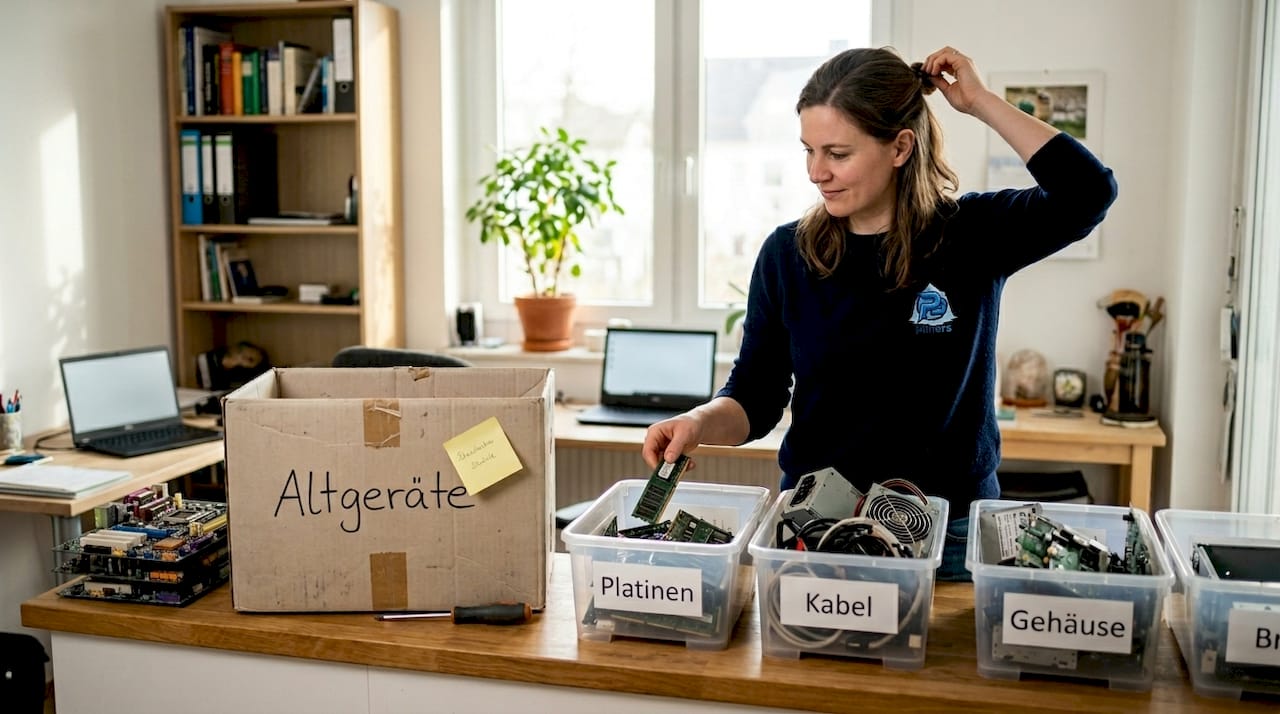
- Sort accessories: Pack cables, power supplies, and heatsinks separately. Many providers evaluate these components individually.
ReUsed-IT individually checks each GPU for condition and value before a recycling decision is made. This shows that professionals always distinguish between "still usable" and "really scrap."
"A well-prepared device often fetches 30 to 50 percent more when purchased than an uncleaned, unreset device."
A practical example of refurbishment shows how much potential lies in seemingly outdated hardware. Sometimes, a simple update is enough to make a miner productive again.
Pro-Tip: Thoroughly dust GPU and ASIC with compressed air before handing them in. Clean devices are valued higher by recycling partners and have a significantly better chance of refurbishment instead of shredding.
Main Step: Recycling Workflow in Detail
Once your device is prepared, the actual recycling work begins. This is where truly sustainable practices are separated from those that only appear to be so. The process differs depending on whether you are recycling a GPU or an ASIC.
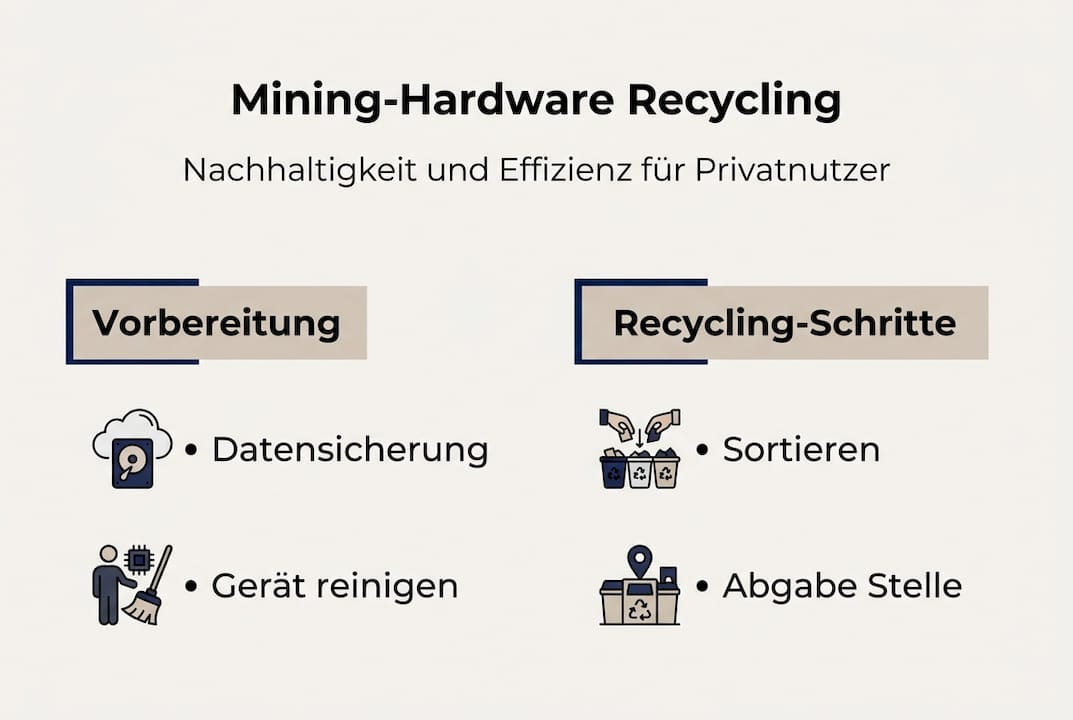
The recycling workflow in steps:
- Dismantling: Open the casing, separate fans, heatsinks, and circuit boards. Collect screws and metal casings separately.
- Component sorting: Separate reusable parts (fans, heatsinks, power supplies) from unusable parts.
- Precious metal recovery: Circuit boards contain gold, silver, copper, and palladium. Up to 98 percent of precious metals can be recovered from GPUs, and up to 100 grams of metal from a single ASIC.
- Material-specific processing: Mechanical sorting is more important than chemical processes for specific materials and achieves better purity levels.
- Handover to certified partner: Pack, ship, or hand in personally, request disposal certificate.
| Feature | GPU Recycling | ASIC Recycling |
|---|---|---|
| Precious Metal Content | High (Au, Ag, Cu) | Very High (Au, Pd, Cu) |
| Reusable Parts | Fans, Memory, PCIe | Hashboards, Power Supplies |
| Refurbishment Chance | Medium to High | Medium |
| Recycling Effort | Moderate | Higher (more chips) |
| Certification Requirement | Yes | Yes |
An often-overlooked point: casings and passive heatsinks are usually made of aluminum or copper and can be sold separately as scrap metal for good proceeds. Those who simply hand in these parts with the rest are missing out on potential revenue.
The optimal cooling for Bitaxe miners, by the way, shows how modern home devices can be designed from the outset for easy disassembly and recyclability. This is no accident but conscious design.
Pro-Tip: Always recycle casings and passive heatsinks separately. Aluminum and copper fetch significantly better prices as sorted scrap metal than in a device mix. More on the Solo Mining background and why hardware quality is crucial from the start.
Completion and Control: Results, Environmental Benefits, and Documentation
The workflow is complete. But how do you know if everything was done correctly and as sustainably as possible? Documentation here is not a bureaucratic burden, but your proof to authorities, buyers, and yourself.
Checklist after recycling:
- Keep the disposal certificate: The certified partner issues a document confirming proper disposal. Keep it for at least three years.
- Secure the data deletion protocol: If you commissioned professional data deletion, you will receive a certificate. This is mandatory for GDPR-relevant devices.
- Document material proceeds: Note which components were handed in at what value. This is relevant for tax returns if mining is operated as a business.
- Check for sources of error: Were there components without proof? Were all data storage devices completely erased? Gaps here can have legal consequences.
| Document | Retention Period | Purpose |
|---|---|---|
| Disposal Certificate | 3 Years | ElektroG Proof |
| Data Deletion Certificate | 5 Years | GDPR Compliance |
| Material Proceeds Receipt | 7 Years | Tax Relevance |
| Photos of Device Condition | 2 Years | Liability Protection |
The numbers speak for themselves: 69 percent of IT hardware is reused, and 87 percent of mining e-waste does not end up in landfills if recycled properly. This is not a given, but the result of consistent processes like the one described here.
"Recycling 1 ton of e-waste saves an average of 1.5 tons of CO2 compared to the primary production of new raw materials."
Anyone who wants to improve their ecological footprint will find one of the most effective levers in a consistent recycling workflow. Typical errors such as missing certificates or incomplete data deletion can be avoided with a simple checklist.
Our Assessment: Why Refurbishment is the Real Game Changer
Now that you know how the process works in detail, here's our professional perspective on your biggest lever: recycling is good. Refurbishment is better. That may sound provocative, but it's true.
Anyone who immediately sends an old ASIC to the recycler without checking whether a new fan, a firmware update, or a thorough cleaning could make the device usable again is wasting resources and money. Quiet, refurbished ASICs are well-suited for home operation and increase efficiency because they are already broken in and don't come with the teething problems of new hardware.
For private miners operating in their living room or office, noise is a crucial factor. A refurbished device with a replaced fan and adjusted firmware can run quieter than a brand-new model. The Eco Line cooling components show how targeted upgrades can transform existing hardware.
Our clear tip: only recycle when refurbishment is genuinely no longer an option. First, check, then repair specifically, and only hand over what can no longer be usefully utilized to the recycling circuit.
Next Steps: Sustainable Mining with Modern Hardware
Do you want to get started right away and use modern, sustainable hardware? Then you'll find the right components here. Those who choose quiet, efficient devices when buying new hardware lay the foundation for a simpler recycling workflow in the future.
At polarblocklabs.com, you'll find efficient mining solutions designed from the ground up for home suitability, low noise, and easy maintenance. Made in Germany here means: high-quality workmanship, long lifespan, and reduced recycling needs due to durability. Complement your setup with quiet cooling options that keep your miner thermally optimal while reducing power consumption. Sustainable mining starts with the right hardware decision.
Frequently Asked Questions
Why does mining hardware have to be recycled in Germany?
The ElektroG (Electrical and Electronic Equipment Act) obliges private individuals to dispose of mining hardware in an environmentally sound manner, as ASICs and GPUs are considered electrical devices and are not allowed in household waste.
How do I securely erase data on ASICs and GPUs before disposal?
By performing a full reset according to manufacturer specifications and, if necessary, using special data wipe software, data can be removed in compliance with ISO 27001/GDPR, ensuring data protection.
What to do with defective mining ASICs that no longer work?
Specialized providers such as ReUsed-IT or K&P handle professional recycling and also check for existing opportunities to refurbish individual components.
How much CO2 can be saved by recycling mining hardware?
On average, approximately 1.5 tons of CO2 are saved per ton of recycled e-waste, compared to the energy-intensive extraction of new raw materials from primary sources.
Recommendation
- NMminer TV 1 MH/s – compact miner for efficient mining – Polarblocks
- PolarBlock Labs – Premium Bitaxe Miner & efficient mining hardware – Polarblocks
- Secure stable hashrates with the Low Profile Plus Bitaxe Cooler – perfect cooling for Bitaxe Gamma Overclocking and efficient mining. – Polarblocks
- Power Supply 5V 25W, 5A for Bitaxe – reliable energy – Polarblocks


