

Mining Performance Management: Efficiency & Sustainability 2026
TL;DR:
- Modern Mining Performance Management approaches optimize power consumption, cooling, and hardware for efficiency.
- Key metrics include hashrate, Joules/TH efficiency, and electricity costs, especially for home mining.
- Sustainable mining uses flexible energy sources, waste heat recovery, and demand-based control for a better environmental footprint.
Home mining is considered by many to be a relic from the early days of Bitcoin when a normal laptop could still mine blocks. Today, many dismiss home mining as unprofitable and energy-intensive. But this perspective is too narrow. Modern approaches show that targeted Mining Performance Management makes the difference between pointless power consumption and sustainable, efficient operation. Those who know the right metrics, choose the appropriate hardware, and use energy wisely can unlock real opportunities as private users. This article explains what the term entails, which metrics truly matter, and how to optimize home mining step by step.
Table of Contents
- Fundamentals and Goals of Mining Performance Management
- The Most Important Metrics: Efficiency, Consumption, and Profitability
- Sustainability and Flexible Energy Use in Mining
- Practical Implementation: Mining Performance Management Step by Step
- Experiences: What Really Matters in Home Mining
- How PolarBlock Labs Optimizes Your Mining
- Frequently Asked Questions about Mining Performance Management
Key Takeaways
| Point | Details |
|---|---|
| Efficiency matters more than hashrate | For home use, economical, quiet operation is more important than maximum performance. |
| Sustainability through energy management | Flexible use and heat recovery can make mining more environmentally friendly. |
| Targeted Performance Management provides advantages | Those who know and manage metrics reduce costs, increase yield, and protect the grid. |
| Home Mining: Community and Sats Stacking | Decentralized mining strengthens the network and keeps knowledge within the community. |
Fundamentals and Goals of Mining Performance Management
Mining Performance Management describes the targeted control and optimization of all factors influencing a miner's operation. These include not only hashrate and power consumption but also cooling, noise levels, pool strategy, and device lifespan. As a bridge between energy consumption, efficiency, and profitability, it connects technical parameters with economic goals.
A common misconception is: higher hashrate automatically means more revenue. This is only partially true. While a higher hashrate increases the probability of finding a block or generating pool shares, if disproportionately more power is consumed, net profitability decreases. The crucial factor is the ratio of computing power to energy input.
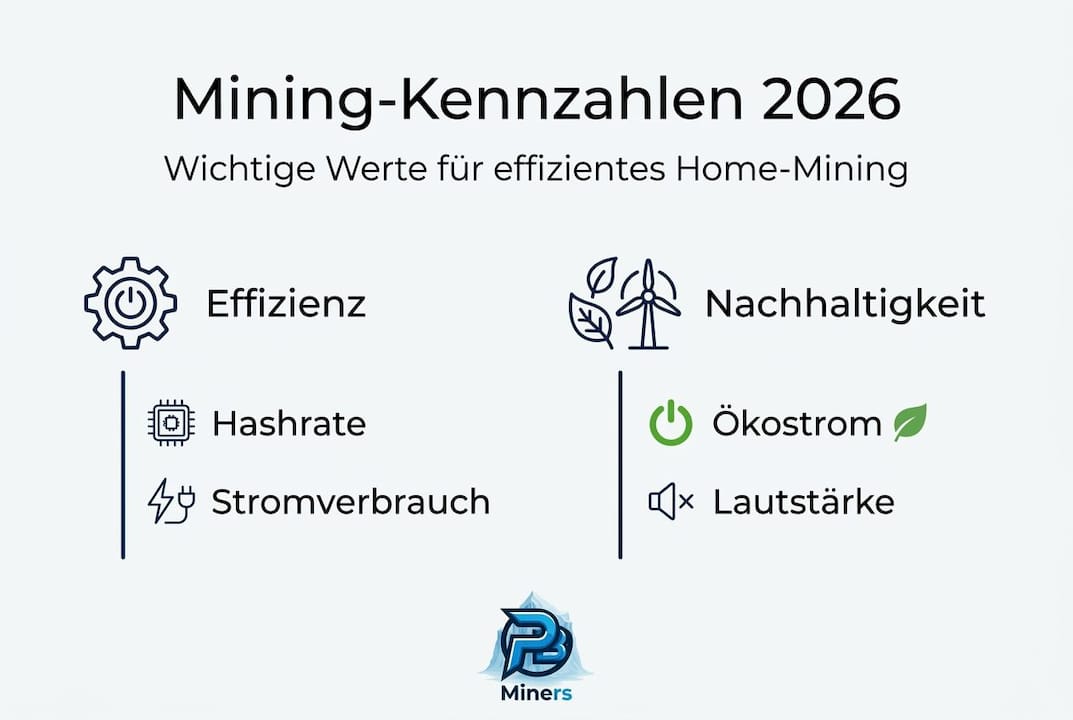
For private users, different standards apply than for industrial operators. At home, factors such as noise level, heat generation, and integration into daily life play a central role. What good is a powerful miner that keeps you awake at night or heats up your home in summer? Good performance management therefore considers the overall picture.
The most important goals at a glance:
- Maximize efficiency: Achieve as much hashrate as possible per watt of power
- Reduce costs: Minimize power consumption and operating costs
- Ensure sustainability: Guarantee hardware longevity and gentle energy use
- Maintain quality of life: Keep noise and heat within an acceptable range
- Optimize pool strategy: Make the right choice between solo and pool mining
Pro tip: Don't view your miner in isolation. The interplay of power consumption, cooling, noise level, and solo mining strategy determines overall success, not a single metric alone.
Especially for beginners, it is important to understand that performance management is not a one-time setup. It is a continuous process. Hardware ages, electricity prices change, network difficulty increases. Those who regularly review and adjust will remain at an advantage in the long term.
The Most Important Metrics: Efficiency, Consumption, and Profitability
Without the right numbers, you're fumbling in the dark. In Mining Performance Management, there are some core metrics that you should know and monitor regularly.
The hashrate measures how many calculations your device performs per second. It is expressed in units such as MH/s (megahash), GH/s (gigahash), or TH/s (terahash). A higher hashrate increases the chance of mining rewards but says nothing about economic viability on its own.
More crucial is efficiency, measured in Joules per Terahash (J/TH). This value indicates how much energy your device needs for a specific computing power. Industrial miners focus on sub-10 J/TH, while home solutions excel with other strengths: low base consumption, quiet operation, and easy integration into the home.
For home use, the following guidelines are reasonable:
- Power consumption under 150 watts for continuous operation
- Noise level under 40 decibels, comparable to a quiet office
- Efficiency in the range of 15 to 30 J/TH for current home hardware
- Profitability calculated regularly based on current electricity prices
Example device values in comparison:
| Device | Hashrate | Consumption | Efficiency | Noise Level |
|---|---|---|---|---|
| Bitaxe Gamma 601 | 1.2 TH/s | 15 W | 12.5 J/TH | under 35 dB |
| NMminer TV | 1 MH/s | 12 W | very low | under 30 dB |
| Antminer S19 XP | 140 TH/s | 3010 W | 21.5 J/TH | over 75 dB |
| Whatsminer M50 | 126 TH/s | 3276 W | 26 J/TH | over 75 dB |
The table makes it clear: industrial devices provide enormous computing power but are simply unsuitable for home use. A compact miner in comparison shows that quiet and energy-efficient hardware is clearly the better choice for private users.
When calculating profitability, you must include the current Bitcoin price, network difficulty, and your electricity price. In Germany, the household electricity price in 2026 is around 30 to 40 cents per kilowatt-hour. This means that even small differences in consumption have a noticeable impact on the balance sheet. Those who operate their miner with green electricity or solar power significantly improve the calculation.
Sustainability and Flexible Energy Use in Mining
Sustainable mining sounds like a contradiction in terms. However, there are concrete methods to significantly reduce the ecological footprint while simultaneously lowering costs.
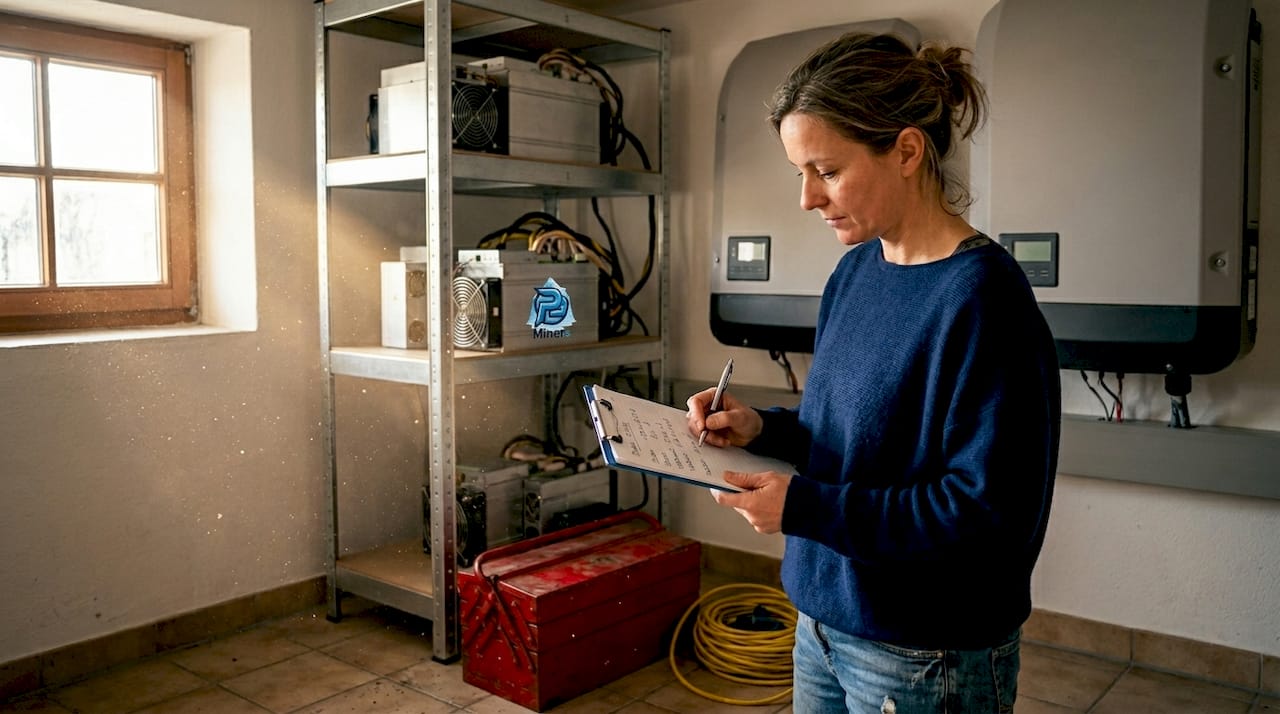
Load management means adapting the miner's operation to the availability of cheap or renewable energy. If you have a photovoltaic system on your roof, you can operate the miner with solar power during the day and pause it at night. This simultaneously reduces costs and CO2 emissions. Flexible loads and heat recovery help make mining more sustainable and efficient.
Another potential lies in waste heat utilization. Every miner generates heat as a byproduct. Instead of simply wasting it, you can use it wisely:
- Heating small rooms or offices in winter
- Temperature control for aquariums or terrariums
- Supporting indoor farming and plant cultivation
- Water heating in combination with special immersion systems
Pro tip: Inform yourself about demand-response programs from your electricity provider. With variable tariffs, you can automatically ramp up your miner when electricity is particularly cheap, for example, at night or during high feed-in of renewable energies.
Comparison: Mining with and without energy management
| Scenario | Monthly Electricity Costs | CO2 Burden | Efficiency |
|---|---|---|---|
| Without Management, Basic Tariff | high | high | low |
| With Solar Power, Daytime | very low | minimal | high |
| With Variable Tariff, Optimized | medium | medium | good |
| With Waste Heat Utilization | medium | reduced | very high |
“Sustainable home mining is not a contradiction. Those who manage energy smartly benefit twice: lower costs and a clearer conscience.”
Knowing the right heatsink comparison is not a luxury, but a basic prerequisite. Good cooling keeps the operating temperature low, extends the hardware's lifespan, and reduces the energy requirement for heat dissipation.
Practical Implementation: Mining Performance Management Step by Step
Theory is good, practice is better. Here's a clear guide on how to implement Mining Performance Management at home.
- Select hardware: Choose a miner with low power consumption under 150 W, quiet cooling under 40 dB, and good efficiency for its performance class. Look for easy maintainability and spare parts availability.
- Optimize location: Place the miner in a well-ventilated area that is not directly in the living space. Basements, utility rooms, or a separate room are ideal.
- Set up monitoring: Use tools such as the integrated web server of modern Bitaxe miners or external monitoring software to keep an eye on hashrate, temperature, and consumption continuously.
- Choose pool or solo: Consider whether pool mining for regular small returns or solo mining for the chance of an entire block better suits your goals.
- Check energy source: Verify if solar power, a variable tariff, or demand-response programs are available.
- Regularly optimize: Review efficiency, costs, and returns every four to six weeks. Adjust settings to changing conditions.
Common mistakes you should avoid:
- Ignoring overheating: Excessively high temperatures drastically reduce lifespan and lower efficiency
- Wrong pool choice: Not every pool fits every hardware, fees and payout models vary greatly
- Underestimating electricity costs: Always calculate with the real price including all charges
- Set up once and forget: Mining is not a set-and-forget system
Even with marginal profitability, mining is worthwhile for decentralization and sats stacking, especially in pool operation. The learning effect and active participation in the Bitcoin network are values that cannot be measured in cents per day.
Pro tip: Small adjustments like better cooling for Bitaxe or an optimized fan can increase efficiency by 5 to 15 percent without having to buy new hardware.
Experiences: What Really Matters in Home Mining
After years in the home mining community, one thing stands out: many beginners overestimate short-term profitability and underestimate the actual added value. The monthly returns of a home miner will rarely cover the electricity bill. That's the honest truth.
But that's not what home mining is all about. The real value lies in the learning effect, in active participation in the decentralization of the Bitcoin network, and in continuous sats stacking over time. Those who view mining as a long-term project, not a quick profit, are clearly at an advantage.
The industry optimizes for maximum hashrate and minimum cost per TH. Home miners can and should set different priorities: quiet operation, easy maintenance, sustainability, and community integration. The NerdQaxe++ Community Feedback shows exactly that: users appreciate the combination of performance, noise level, and connection to a like-minded community.
Pro tip: Invest in networking and know-how. Active exchange within the community brings more than chasing the next efficiency record.
How PolarBlock Labs Optimizes Your Mining
If you now know what matters in Mining Performance Management, the question of the right hardware arises. PolarBlock Labs develops and manufactures Bitcoin Home Miners specifically for home use, handcrafted and calibrated in Germany.
The devices are designed for quiet, efficient continuous operation, exactly what private users need. Whether you're starting with the NMminer TV 1 MH/s or optimizing your existing hardware with a high-quality Bitaxe cooling solution, PolarBlock Labs offers you the right solutions for sustainable, quiet home mining. Limited editions, German quality, and an active community make the difference.
Frequently Asked Questions about Mining Performance Management
What is Mining Performance Management, in a nutshell?
It's about the targeted optimization of mining in terms of efficiency, power consumption, and sustainability. As an integral component between energy consumption and profit, it is specifically tailored to the needs of home users.
What are the most important key figures for home mining?
Crucial factors are power consumption, efficiency in Joules/TH, noise level below 40 dB, and profitability after electricity costs. Industrial miners aim for sub-10 J/TH as a benchmark, while home devices excel in other areas.
How can home mining be made more sustainable?
With load management, the use of green electricity, waste heat utilization, and demand response programs, mining becomes significantly more sustainable. Flexible loads and heat recovery measurably increase both sustainability and efficiency.
Is home mining still worth it in 2026?
Even if profitability is low, home mining is worthwhile for new experiences, decentralization, and Sats-stacking, especially in a pool. Home mining remains meaningful for decentralization and offers long-term value beyond mere profitability.


