
Bitaxe Mining Security: Your Self-Sufficient Home Office Setup
TL;DR:
True mining security means physical hardware, not cloud scams. The Bitaxe Gamma 601 ("Made in Germany") runs at a whisper-quiet 15 watts and is absolutely fire-safe for the home office. Thanks to the closed AxeOS Dashboard, you mine securely and directly to your own wallet without complex IT firewalls.
When beginners think of "Bitcoin mining security," their thoughts often revolve around hacker attacks, overheating cable fires, or complicated tax and IT regulations. This may apply to industrial data centers. However, for solo mining in a home office, entirely different rules apply thanks to state-of-the-art ASIC chips.
We'll show you why true security in 2026 means having the hardware on your own desk, and how to protect yourself from the real dangers of the crypto world – all without an IT degree.
The Biggest Danger: Cloud Mining (Not your Hardware, Not your Hash)
The highest security risk in the crypto space is not complex network attacks on the blockchain, but disreputable "cloud mining" providers. You pay for alleged computing power somewhere abroad, but have zero physical control. These are often Ponzi schemes (fraud) that disappear overnight.
The only secure solution for financial sovereignty is a physical Bitcoin miner without cloud dependency. The Bitaxe Gamma 601 is your private, self-sufficient lottery ticket printer. It's at your place, it's yours – that's true security and physical inflation protection.
Physical Security: Why 15 Watts Makes All the Difference
Industrial ASIC miners often consume over 3,000 watts. They are deafeningly loud and represent a massive burden on the power grid and a real fire hazard in normal homes. The BM1370 chip in the Bitaxe Gamma completely reverses this concept.
Security Check: Outdated Miners vs. Bitaxe Gamma
| Security Aspect | Outdated Industrial Miners | Bitaxe Gamma 601 (Home Office) |
| Power Consumption & Fire Hazard | 3,000+ Watts. Often require special heavy-duty cables and extreme room cooling. | Tiny 15 Watts power consumption. Runs fire-safe with a 25W standard power supply (Plug & Play). |
| IT & Network Security | Complicated router port forwarding and firewall rules required. | AxeOS connects securely via standard WLAN. No open ports, no stress. |
| Quality Control | Often used, untested electronics from the Far East. | "Made in Germany" final assembly in Bavaria. Includes stress test and high-quality Arctic MX-6 thermal paste. |
Plug & Forget: Mine Directly to Your Own Wallet
Security for Lottery Mining Germany also means that no one can freeze your earnings. When you set up your Bitaxe via the AxeOS Dashboard, you simply deposit your personal Bitcoin address (e.g., from your hardware wallet). If you hit the block reward of currently 3.125 BTC, the reward goes directly to you – without intermediaries, without account blocks.
Forget complicated server monitoring. Your miner runs completely autonomously 24/7. That's absolute Peace of Mind.
FAQ: Home Mining Security
-
Do I need to protect myself from viruses or hackers?
No. The Bitaxe's AxeOS is a closed system built for a single purpose: SHA-256 hashing. It is immune to regular PC viruses.
-
Is the operation legally secure?
Absolutely. Operating crypto hardware for lottery mining for private use is completely legal. Since you do not have fixed, guaranteed income, but participate in a lottery in solo operation, the panic surrounding complicated business registrations is usually unnecessary for hobby miners.
-
What happens in the event of a power outage at home?
As soon as power and Wi-Fi are restored, the Bitaxe Gamma automatically reboots thanks to its firmware and immediately resumes solo mining. You do not need to intervene manually.
How Does Mining Security Work? Consensus, Block Rewards, and Tamper Protection
The process of a successful block is clearer than many think. Here's the step-by-step process:
- New transactions are collected on the network and temporarily stored in a so-called mempool.
- Miners select transactions from the mempool and build a candidate block from them.
- Each miner searches for a "nonce," a number that makes the block valid.
- The first miner to find the correct nonce sends the block to the network.
- Other miners check the block and confirm it if it is valid.
- The winner receives the block reward of 3.125 BTC plus transaction fees.
This process repeats every ten minutes. Decentralized consensus protects against central control because no single entity can decide which block is valid.
What happens in an attack? A so-called 51 percent attack would require an attacker to control more than half of the total hashrate. Given the current network size, this would simply not be financially feasible. The costs would be in the billions.
| Security Aspect | Outdated Industrial Miners | Bitaxe Gamma 601 (Home Office) |
| Power Consumption & Fire Hazard | 3,000+ Watts. Often require special heavy-duty cables and extreme room cooling. | Tiny 15 Watts power consumption. Runs fire-safe with a 25W standard power supply (Plug & Play). |
| IT & Network Security | Complicated router port forwarding and firewall rules required. | AxeOS connects securely via standard WLAN. No open ports, no stress. |
| Quality Control | Often used, untested electronics from the Far East. | "Made in Germany" final assembly in Bavaria. Includes stress test and high-quality Arctic MX-6 thermal paste. |
| Attack Type | Description | Feasibility |
|---|---|---|
| 51 Percent Attack | Control over >50% of hashrate | Extremely unlikely |
| Double-Spending | Spending the same Bitcoin twice | Prevented by PoW |
| Sybil Attack | Many fake network nodes | Ineffective due to PoW |
| Selfish Mining | Withholding blocks for advantage | Theoretical, hardly practical |
For home office miners, this is an important realization. Those who understand solo mining know that even small devices with a few terahash contribute to overall security. Every hashrate counts.
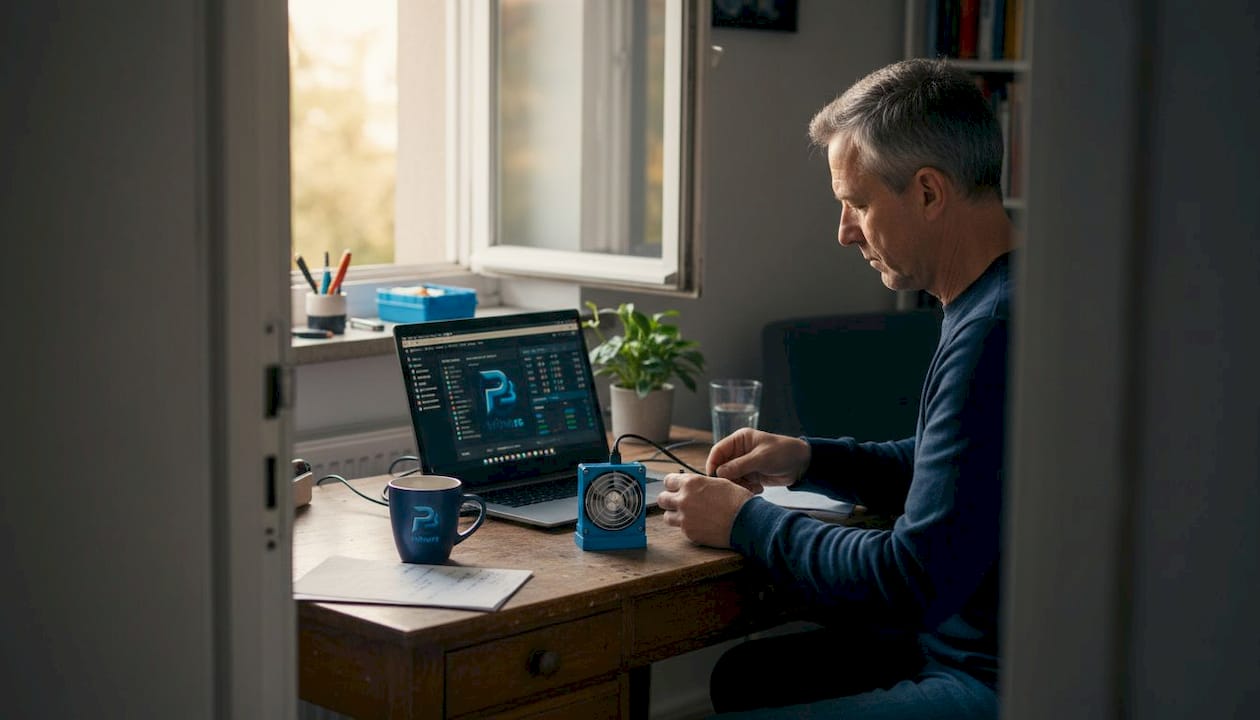
Pro-Tip: In solo mining, your device sends its hashrate directly to the network, without going through a pool. This means the full block reward goes to you if your miner finds the block.
Risks and Challenges: Pool Monopolies, Profitability, and Decentralization
The network itself is secure. But there are structural risks that private users should be aware of.
“Network security is high and the system has never been hacked. But pool concentration with two pools over 51% leads to ongoing debates about true decentralization.”
That is the real problem. Large mining pools combine the computing power of many miners and share the rewards. This sounds fair, but it has a downside. If two or three pools together control more than half of the total hashrate, a theoretical concentration of power arises. This contradicts the basic idea of Bitcoin.
The main risks for private users:
- Pool dependence: Those who mine in a pool give up control over their hashrate.
- Fees: Pools charge fees of one to three percent on all rewards.
- Profitability: Without photovoltaics or cheap electricity sources, profitability for private users is marginal.
- Centralization risk: Too many miners in the same pools weaken decentralization.
- Cloud mining fraud: Many providers promise mining profits without their own hardware. This is almost always a scam.
Pro-Tip: Before purchasing a cloud mining contract, always check whether the provider can demonstrate verifiable hardware and transparent billing. Reputable providers are the absolute exception.
The community's role in mining is often underestimated. When more private users mine solo, the hashrate is distributed more widely. This strengthens the entire system. It is not a romantic ideal, but a mathematical fact.
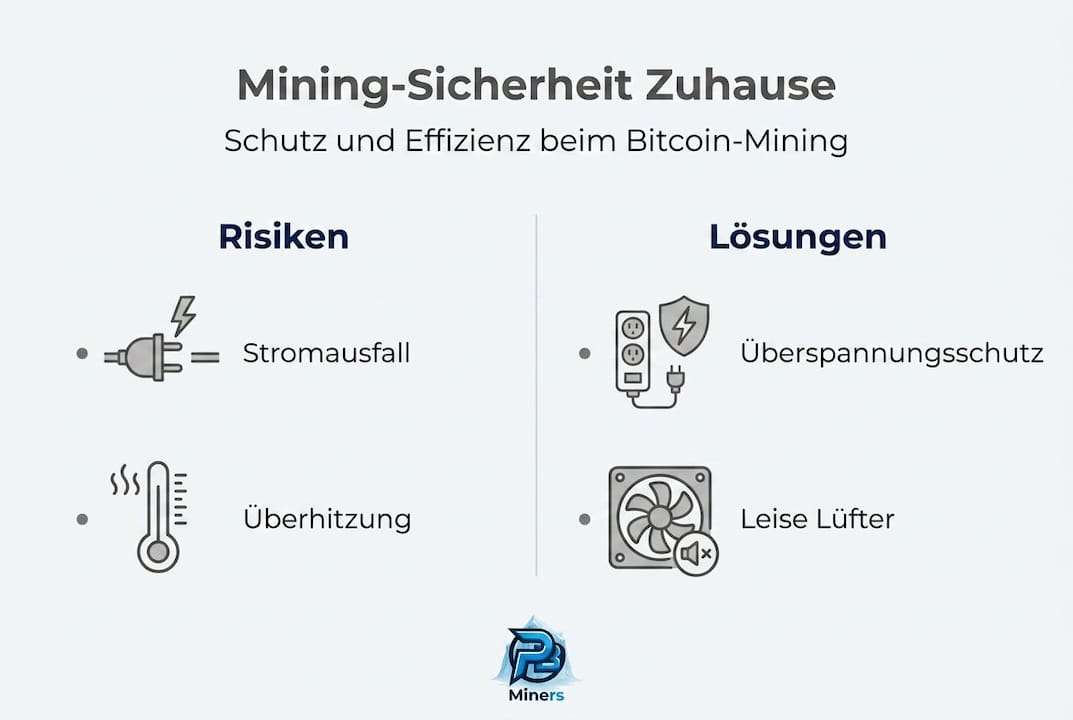
Best Practices for Secure and Sustainable Home Office Mining Setups
You don't have to be an engineer to mine at home. But a few basic rules help make the setup safe, quiet, and efficient.
| Factor | Recommendation | Why important |
|---|---|---|
| Power Supply | 230V power supply with overvoltage protection | Protection against hardware damage |
| Noise | Premium fan, insulated casing | Suitability for everyday home office use |
| Automation | HomeAssistant with PV integration | Reduce costs, increase efficiency |
| Taxes | Report mining as business income | Legal certainty in Germany |
| Hardware Quality | Tested devices with stress test | Stable hashrate, no failures |
The practical recommendations for the German-speaking region include noise insulation, 230V power supplies, PV automation, and correct tax treatment as business income. Cloud mining should generally be avoided.
Here's what a good home office setup looks like:
- Choose hardware: Efficient devices like the Bitaxe with 15 to 21 watts of consumption are ideal for home use.
- Optimize power: If you have photovoltaics, you can operate the miner during the day with solar power and drastically reduce costs.
- Set up automation: Tools like HomeAssistant automatically turn on the miner when cheap electricity is available.
- Tax recording: Mining income in Germany is taxable as income. Keep accurate records of all blocks found and earnings.
- Protect hardware: Regular cleaning of fans, stable power supply, and good ventilation significantly extend lifespan.
Pro Tip: Learn about hardware protection and follow current mining trends to keep your setup efficient in the long run.
Sustainability also plays a role. Efficient hardware consumes less power per terahash. This saves money and protects the environment. If you eventually replace your old miner, you should look for recycling programs.
Our Perspective: What Private Users and Idealists Often Overlook in Mining
Many people considering home mining ask the wrong question. They ask, “When will the device pay for itself?” The right question is, “What am I contributing to the network?”
Hashrate growth signals network health, and halvings increase efficiency pressure. Home miners strengthen decentralization despite low profitability. This is not an excuse for poor returns. It's a different way of measuring value.
Anyone who operates a small miner at home does something that no ETF or exchange can achieve. They physically secure the network. Their device is a true node in the decentralized system. This has a value that cannot be expressed in euros.
Halvings make this point even clearer. After each halving, the block reward decreases. This forces miners to be efficient. Those who mine with 15 watts will still be there after the next halving. Those who rely on huge machines for maximum returns are fighting against rising electricity costs.
The efficiency of home mining will become more, not less, important in the future. Small, efficient devices are not toys. They are the sustainable answer to a market that is becoming increasingly expensive.
Your Next Steps: Discover Efficient Mining Solutions for Home
You now know how mining security works and what is important for a good home office setup. The next step is to find the right hardware.
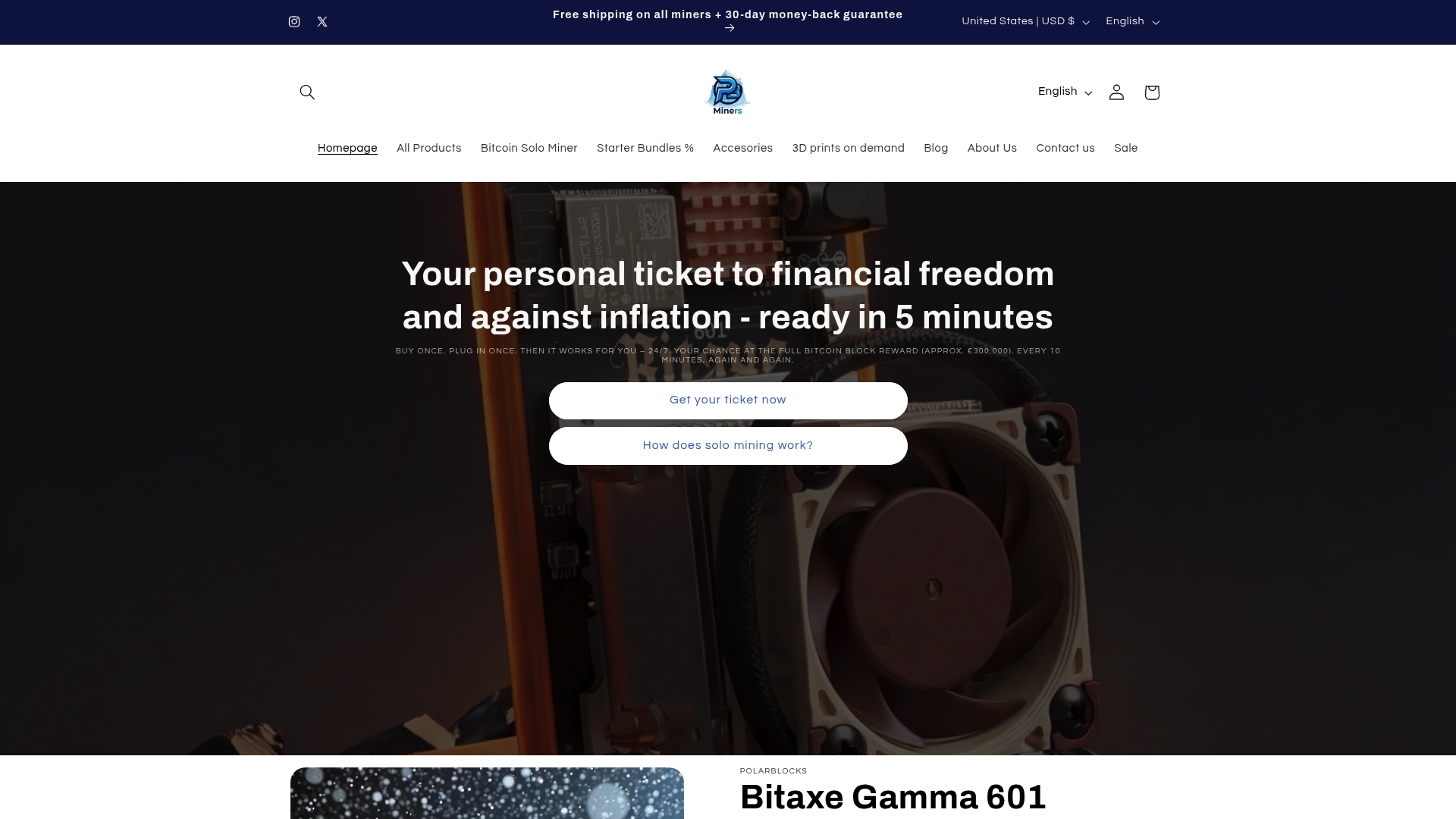
Polarblocks offers Bitcoin Solo Miner solutions specifically designed for the German-speaking home market. Each device is hand-assembled in Bavaria, equipped with premium fans, and stress-tested before shipping. No pool, no fees, no compromises. A concrete example is the Bitaxe Gamma 601, which runs stably with minimal power consumption and is delivered ready for immediate use. All starter bundles and miners are covered by a 30-day money-back guarantee.
Frequently Asked Questions
Why is mining security so important for the Bitcoin network?
Mining security prevents manipulation by decentralizing transaction validation via Proof-of-Work, ensuring no single actor can control the system.
What are the risks of mining in pools instead of as a solo miner?
Pool concentration above 51% is the subject of active decentralization debates and could theoretically endanger the network's independence.
How can I make my mining setup secure and efficient in my home office?
Pay attention to tested hardware, sound insulation, and PV automation, and correctly record mining profits as business income.
Why are home miners valuable for the network despite low returns?
Home miners strengthen decentralization and contribute to the long-term security of the network, regardless of their individual profitability.
Recommendation
- Optimal Protection for Mining Hardware: Sustainable and Quiet at Home – Polarblocks
- Independent Mining: More Control and Sustainability for Private Users – Polarblocks
- The Best Mining Trends for Sustainable Bitcoin Mining – Polarblocks
- The Central Role of the Community in Bitcoin Mining 2026 – Polarblocks


