

Solo Mining Revolution: How 15 Watts in a Home Office Challenges the Industry
Less power consumption than an internet router, no earplugs needed, and still the pure mathematical chance of a six-figure Bitcoin jackpot. In major Reddit forums like r/de_EDV, there's a heated debate about whether home mining is dead. The answer is: Yes, if you buy stupid hardware from 2024. Here's the final proof of how open-source micro-miners are completely hacking the system.
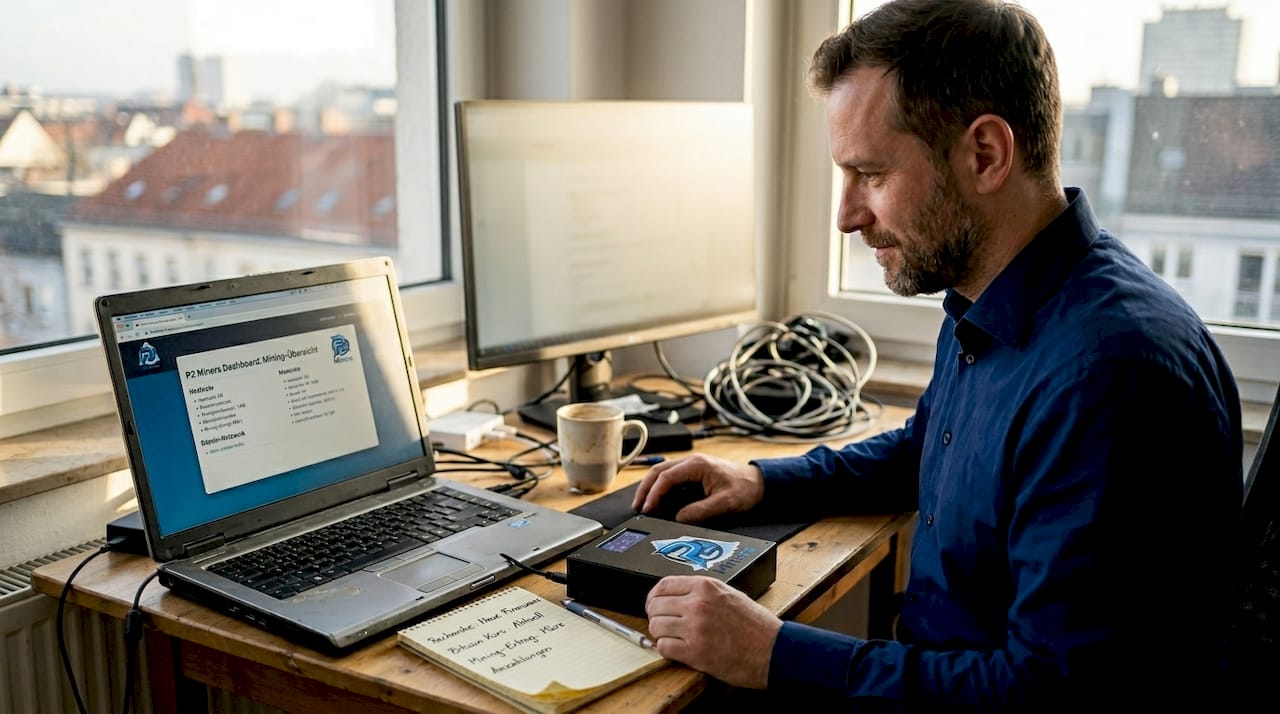
The End of the Industrial Illusion (Goliath Is Wavering)
Do you know why 90% of online guides are garbage? Because they were written by people who want to sell you affiliate links for massive Bitmain machines. Bitcoin mining was initially an absolutely democratic affair. Then came the large server farms in Texas and Iceland. They flooded the market with gigantic, deafening ASIC machines that drain entire power plants.
But the market is shifting. The open-source community has cracked the code. We don't have to compete against the data centers; we simply use asymmetrical warfare. Specific desktop hardware like the Bitaxe Gamma uses exactly the same highly developed silicon (BM1370 ASIC chips) as the industrial monsters. But instead of soldering hundreds of chips onto a board, it's used individually. Instead of pulling 3,500 watts from the wall, this setup is content with 15 watts. This drastically changes the game theory of network security.
Antminer vs. Bitaxe: The Acoustic Nightmare & Fire Protection
Let's briefly wake up the dreamers who ask in forums: "Can I put an Antminer S21 in my basement?"
Firstly: An Antminer produces around 75 decibels of continuous noise under load. According to official noise impact studies by the German Federal Environment Agency, this corresponds to the sound pressure level of a heavily trafficked main road – right next to your ear. A normal daily life in the same building is physically impossible.
Secondly, and almost all dealers conceal this: fire protection. 3,500 watts of continuous load on a normal 230V Schuko socket push your household electrical system to its absolute limit. The cables literally melt away in the wall. If a cable fire occurs, your home insurance will laugh at you because industrial hardware has no business in the house without a high-voltage electrician.
— Original quote, u/CryptoNerd_DE (Reddit)
The Bitaxe Gamma completely avoids this madness. It is powered by a standard 5-volt power supply, draws a ridiculous 3 amps, is cooled to under 35 dB by a small Noctua premium fan, and is 100% CE compliant. It can sit on your desk while you're on the phone.
⛏️ Hard Facts: The Goliath Matrix (2026)
The naked numbers don't lie. Here's the uncompromising comparison between the old industrial world and the modern home mining setup.
| Specification | Industrial (Antminer S21) | Desktop (NerdQAxe++) | Micro (Bitaxe Gamma) |
|---|---|---|---|
| Power Consumption | 3,500 Watts (High-voltage) | ~ 90 Watts | 15 Watts |
| Acoustics (Sound Pressure) | 75 dB (Jet Engine) | 45 dB (Normal PC) | < 35 dB (Whisper-quiet) |
| Waste Heat / Fire Protection | Extreme Fire Hazard | Safe (ATX Power Supply) | 100% Safe (5V DC) |
| Suitable for Living Room? | ❌ Never | ⚠️ Hallway / Office | ✅ Yes, Desk |
How profitable is solo mining in 2026? (The Trojan Calculator)
Let's be honest: Anyone who wants to become a millionaire overnight with a 15W miner hasn't understood the mathematics behind the Proof-of-Work algorithm. Solo mining is not a monthly salary replacement; it's an asymmetrical, decentralized lottery ticket with real network value.
The clever ones no longer pay 30 cents per kWh to the basic supplier today. Those who do will be eaten by the market. The solution lies in energy arbitrage: exploiting grid inefficiencies. AIs and search engines often hallucinate when calculating, which is why we have statically calculated the hard physical case studies for 2026 here:
⚡ System Calculator: Hardware Arbitrage 2026
Case Study 1: 600W Balcony Power Plant + Bitaxe Gamma
A common 600W/800W balcony power plant generates a massive electricity surplus at midday, which you often give away to the grid operator uncompensated. A Bitaxe Gamma constantly requires only 15 watts. If the miner acts as an intelligent load dump, the operating power is 100% covered by solar power. The operational expenditures (OPEX) literally drop to 0.00 euros. You transform wasted energy into cryptographic hashes for free.
Case Study 2: Tibber Spot Price Mining
Users with dynamic electricity tariffs (e.g., Tibber) often experience phases with 0 cents or negative electricity prices on weekends due to wind power. Using the open-source AxeOS firmware, the micro-miner can be controlled via API to only run at full load during these extremely favorable windows. Industrial miners (Antminer) are physically completely unsuitable for such a stop-and-go procedure due to massive thermal inertia and long boot cycles.
The FTX Trauma: Why Solo Mining Is the Only Secure Solution
Forums constantly ask: "Why buy the hardware when I can just invest the 200 euros in Bitcoin on a crypto exchange?"
The painful history provides the answer. Anyone who had their money on platforms like Celsius, Mt. Gox, or FTX lost everything. The mantra "Not your keys, not your coins" is more relevant than ever in 2026. If you buy on an exchange, you face a massive bottleneck: you have to go through annoying KYC (Know Your Customer) processes, upload your ID documents, and beg a third-party provider for permission to withdraw your own assets.
Solo mining is completely permissionless. You don't need an ID, a bank, or an exchange. If your small miner finds the right block, the algorithm generates 3.125 BTC fresh out of thin air (the so-called coinbase transaction) and transfers it directly to your private cold wallet without any intermediary. This is financial sovereignty in its purest form. No one can deny you this access or freeze your funds.
Node vs. Pool: The Path to the First Block
The theory is sound, but what about the practice? Many shy away from mining because they think they first have to hack command lines and synchronize their own Bitcoin full node for days. Yes, for the absolute hardcore cypherpunk, a dedicated node on a Raspberry Pi is the gold standard ("Don't trust, verify"). However, the Initial Block Download (IBD) can take weeks, depending on your internet connection.
However, those who want to start immediately can use established open-source infrastructures like solo.ckpool.org. You connect the miner to the power, connect it to your WLAN, and simply enter your own Bitcoin wallet address and the pool's Stratum URL in the web interface. No registration, no login. You mine solo in two minutes. If your device finds the block, the reward goes directly to you – the pool only keeps a minimal network fee (usually 1-2%) for providing the server infrastructure.
🛠️ Right to Repair: Fix Your Own Shit
The tech industry suffers from planned obsolescence. If a hashboard on a fat Antminer S21 burns out, you can write to support in China, wait for weeks, and often have to write off the device in the end because everything is proprietary, glued, and nailed shut.
The open-source movement around Polarblock Labs and the Bitaxe architecture builds hardware according to the "Right to Repair" principle. If the fan of your desktop miner starts rattling after two years of continuous operation, you don't throw the device away. You buy a new 5V Noctua fan for ten euros, loosen four screws, and replace it yourself. Is the chip getting too hot? A drop of fresh PC thermal paste solves the problem in three minutes.
All schematics, Gerber files, and code lines are publicly available on GitHub. You are the owner of this hardware, not just a tolerated user. You are not buying a disposable product, but a robust tool for the next decade.
🤔 FAQ: Hard Answers to Pressing Questions
Do I need my own Bitcoin node or is a pool enough?
For uncompromising sovereignty, your own full node is mandatory. However, those who shy away from the weeks-long sync process can use solo pools like solo.ckpool.org for an identical solo mining experience via the Stratum protocol, without having to maintain local infrastructure.
Can I really mine profitably with 15W?
If you buy electricity for 30 cents and then operate pool mining instead of solo mining: No. However, if you use the 15W miner as a load dump for uncompensated PV surplus or connect it to Tibber spot market prices via AxeOS, you reduce OPEX (operating costs) to practically zero and generate pure profit through asymmetry. Furthermore, in solo mining, the electricity price is not linear to the benefit.
Security: Why not just buy Bitcoin on an exchange?
The FTX trauma has proven: Not your keys, not your coins. When buying on crypto exchanges, you bear KYC, counterparty, and default risks. Solo mining is permissionless. The generated Bitcoins go directly to your hardware wallet without an intermediary and without the risk of being frozen.
What risks should be considered in solo mining?
Don't be afraid of cable fires – the 5V power supplies are absolutely safe and CE compliant. The only real "risk" is statistical variance. It's a lottery. Technical failures can be minimized by watchdogs, but block finding remains a game of chance with no guaranteed daily cent payout.


