

Solo Mining: Safe or Scam? Facts & Risks Explained
TL;DR:
- Physical solo mining offers complete control, transparency, and no fees.
- Cloud mining is often opaque and carries high scam risks.
- With suitable hardware and low power consumption, life-changing Bitcoin gains are possible.
TL;DR: Physical hardware in your hands is security. Cloud mining with anonymous promises is often a scam. Anyone running a Bitaxe Gamma 601 at home has real control over their miner, pays no pool fees, and has a real chance at the full block reward every 10 minutes.
A private user with a single device and a 1:100,000 daily chance wins over $222,000 in April 2026. Another with 230 TH/s gets $210,000. Sounds unbelievable? It's not. These successes show that lottery mining in Germany is not a fairy tale but a documented phenomenon with real winners.
Table of Contents
- What Solo Mining Is and How It Works
- Risks, Scams, and Why Solo Mining Is Not a Scam
- Costs, Opportunities, and What Practice Shows
- Who Is Solo Mining Suitable For and What Does It Require?
- Assessment: What Many Overlook on Their Own
- Safely Starting Solo Mining – Finding Suitable Hardware & Advice
- Frequently Asked Questions About Solo Mining
Key Takeaways
| Point | Details |
|---|---|
| Solo Mining is not a scam | As long as you own and operate the hardware yourself, solo mining is safe and transparent. |
| Cloud Mining has high risk | Scams usually arise in cloud mining due to opacity and contractual pitfalls. |
| Financial success is rare | Solo mining is financially worthwhile only with luck; the learning effect is huge. |
| Realistic expectations are crucial | A clear cost overview and suitable hardware prevent frustration for private users. |
What Solo Mining Is and How It Works
Solo mining means: You operate your own miner, connect it directly to the Bitcoin network, and try to find a block by yourself. No pool, no shared earnings, no fees. If your device finds the block, the entire 3.125 BTC is 100 percent yours.
The difference to pool mining is simple. In a pool, thousands of miners work together and share the reward proportionally. This leads to regular, small payouts. Solo mining is the opposite: rarer, but potentially much larger.
And cloud mining? That's a completely different category. With cloud mining, you don't buy hardware. You buy a contract. A provider claims to mine on your behalf and pay you profits. The problem: You have no control, no transparency, and often no real computing power. As Cloud Mining vs. Pool Mining vs. Solo Mining shows, cloud mining carries significant contractual and scam risks, while solo mining on your own hardware is completely transparent and self-determined.
The most important differences at a glance:
- Control: With solo mining, you physically own the hardware.
- Transparency: Every transaction is publicly verifiable on the Bitcoin network.
- Fees: No pool fees, no middleman.
- Risk: No contractual risk, no provider failure.
More on control in solo mining can be found in our detailed article on independence and sustainability for private users.
Pro Tip: Anyone running a Bitaxe with the BM1370 chip uses the same chip type as professional mining rigs, only in a compact, quiet, and energy-efficient version for home use.
Risks, Scams, and Why Solo Mining Is Not a Scam
Many people hear "mining" and immediately think of scams. That's understandable. Headlines in recent years are full of cloud mining scams, Ponzi schemes, and vanished providers. But these cases almost exclusively concern cloud mining, not physical solo mining.
Solo mining is by definition not a scam. You buy a device. You plug it in. It runs. You see the hashrate in real-time. You control the wallet address. There's no middleman you have to trust.
"Solo mining on your own hardware is secure because the user retains full control. Cloud mining, on the other hand, is often opaque and susceptible to dubious providers."
The following table shows the direct comparison:
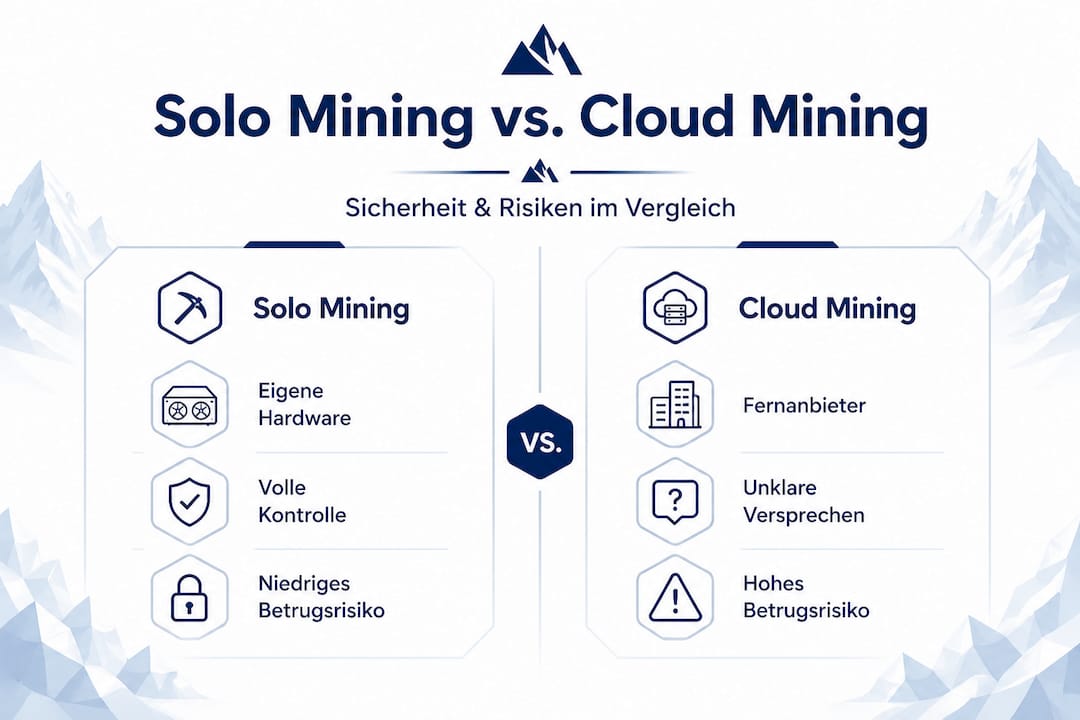
| Criterion | Cloud Mining (Scam Risk) | Bitaxe Solo Mining (Real) |
|---|---|---|
| Control | None, provider decides everything | Complete, hardware in your own hands |
| Power consumption | Unknown, not verifiable | Approx. 15 to 21 watts, like an LED light bulb |
| Physical possession | No device, only contract | Own hardware, Made in Germany |
| Pool fees | High fees plus provider margins | Zero, no pool, no middleman |
| Transparency | No insight into computing power | Hashrate viewable live, blockchain public |
| Scam risk | Very high, many Ponzi providers | None, hardware is real and verifiable |
As Solo Mining vs. Pool Mining proves, owning your own hardware is the only form of mining that guarantees true security. Cloud mining, on the other hand, is often the first step into a trap.
More on Mining Security at Home and the topic of Protecting Mining Hardware can be found in our further articles.
Pro Tip: If a provider promises "guaranteed daily returns," that's a clear red flag. Bitcoin mining has no guaranteed earnings. Anyone who promises this is lying or operating a Ponzi scheme.
Costs, Opportunities, and What Practice Shows
Let's talk about the numbers. Skepticism is good, but facts are better.
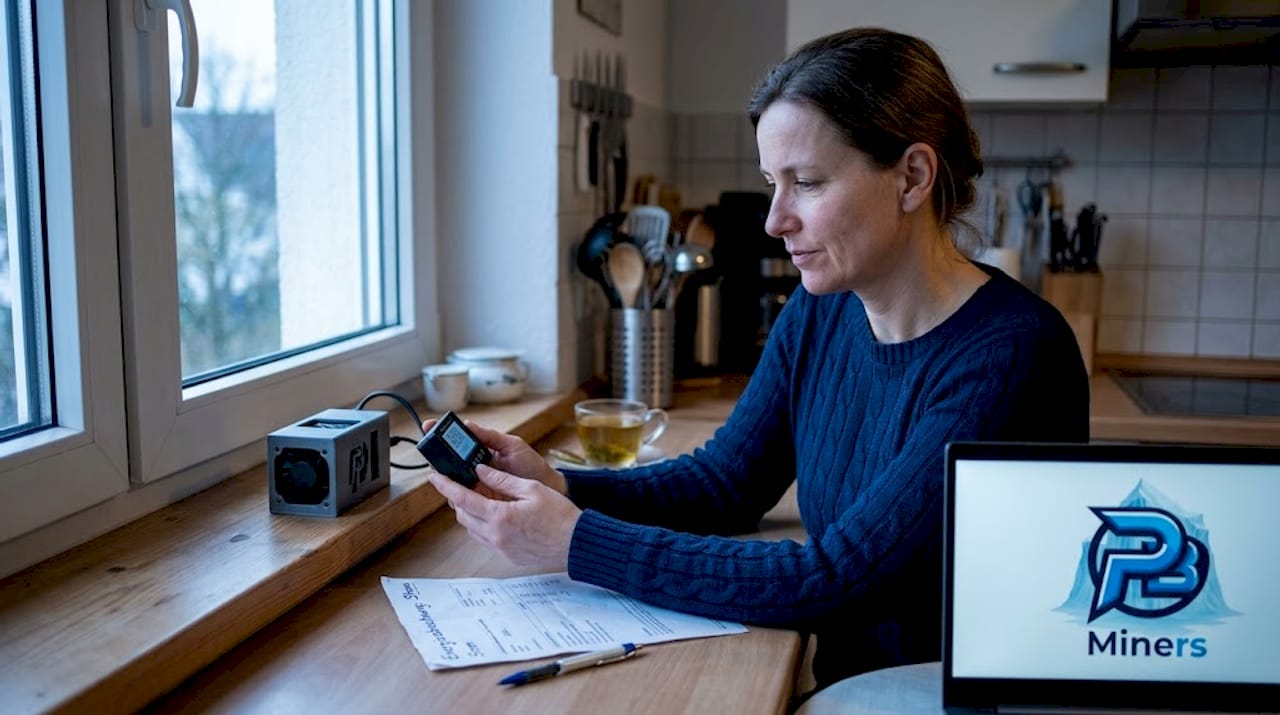
A Bitaxe with the BM1370 chip consumes about 15 to 21 watts. At a German electricity price of 0.30 Euro per kWh, this costs approximately 50 to 55 Euro per year. That's less than an annual subscription for many streaming services. As Blocktrainer explains, normal mining in Germany is economically viable primarily with low electricity costs below 0.12 Euro per kWh, for example, through solar power. At normal household electricity prices, the costs exceed the expected pool earnings. But that's not the primary goal of solo mining.
| Device | Hashrate | Daily Chance | Annual Electricity Costs (0.30 €/kWh) |
|---|---|---|---|
| Bitaxe Gamma 601 | approx. 1.2 TH/s | approx. 1:100,000 | approx. 50 Euro |
| Mid-range Miner | 70 TH/s | approx. 1:50,000 | approx. 1,800 Euro |
| Large Miner | 230 TH/s | approx. 1:28,000 | approx. 6,000 Euro |
The documented successes speak for themselves: CKpool has recorded over 300 solo blocks found by private users since 2014. A miner with 70 TH/s won over $222,000 in April 2026. Another with 270 TH/s got 242,000 Euros.
What does this mean for a Bitaxe operator?
- The chance is small but real and mathematically verifiable.
- The investment is manageable: device plus electricity.
- The potential gain is life-changing: 3.125 BTC at the current rate.
- Operation is passive: set it up once, let it run.
More on community in mining and sustainable mining trends shows how the ecosystem around private users continues to evolve.
Who Is Solo Mining Suitable For and What Does It Require?
Solo mining is not a product for everyone. But for the right person, it's exactly what they need.
As Solo Mining vs. Pool Mining makes clear: If you need regular, predictable income, a pool is better. But if you're looking for independence, transparency, and a chance at the big hit, solo mining offers an honest alternative.
Who benefits from solo mining?
- Tech enthusiasts who want to understand how Bitcoin truly works.
- Private users who don't want to trust any provider and prefer to maintain control themselves.
- People with access to cheap electricity, for example, through photovoltaics.
- Bitcoin fans who want to decentralize the network and actively support it.
- Investors looking for a physical hedge against inflation.
What do you need to get started?
- Hardware: A Bitaxe Gamma 601 or a comparable Bitcoin miner without cloud dependency.
- Electricity: A standard power outlet is sufficient, consumption is 15 to 21 watts.
- Network: A stable internet connection and a Wi-Fi router.
- Wallet: Your own Bitcoin wallet address where the reward will be paid out.
- Patience: Solo mining is not a daily business but a long-term setup.
More on the benefits for private users and a step-by-step guide to starting a mining setup help with getting started.
Pro Tip: The Bitaxe Gamma 601 with BM1370 chip is specifically optimized for home use. Quiet, efficient, and completely open-source. You can check and modify the firmware yourself.
Assessment: What Many Overlook on Their Own
Here's the honest truth: most reports of mining fraud come from the cloud mining sector. Not from physical solo mining. This confusion harms the reputation of a method that is technically sound, transparent, and verifiable.
Solo mining is not a guarantee of regular success. We state that clearly. Anyone expecting monthly income will be disappointed. But anyone who understands that it is a kind of decentralized lottery, where you own the lottery machine yourself, is thinking correctly.
The crucial difference to real scams: with self-directed mining, there are no hidden fees, no contract clauses, and no provider who disappears overnight. The device runs. The blockchain runs. The chance remains.
Community support, transparent hardware, and realistic expectations are key. Those who understand this turn a 300-euro device into a permanent, physical participant in the Bitcoin network.
Safely Starting Solo Mining – Finding Suitable Hardware & Advice
Anyone who wants to try solo mining needs one thing above all: hardware they can trust.
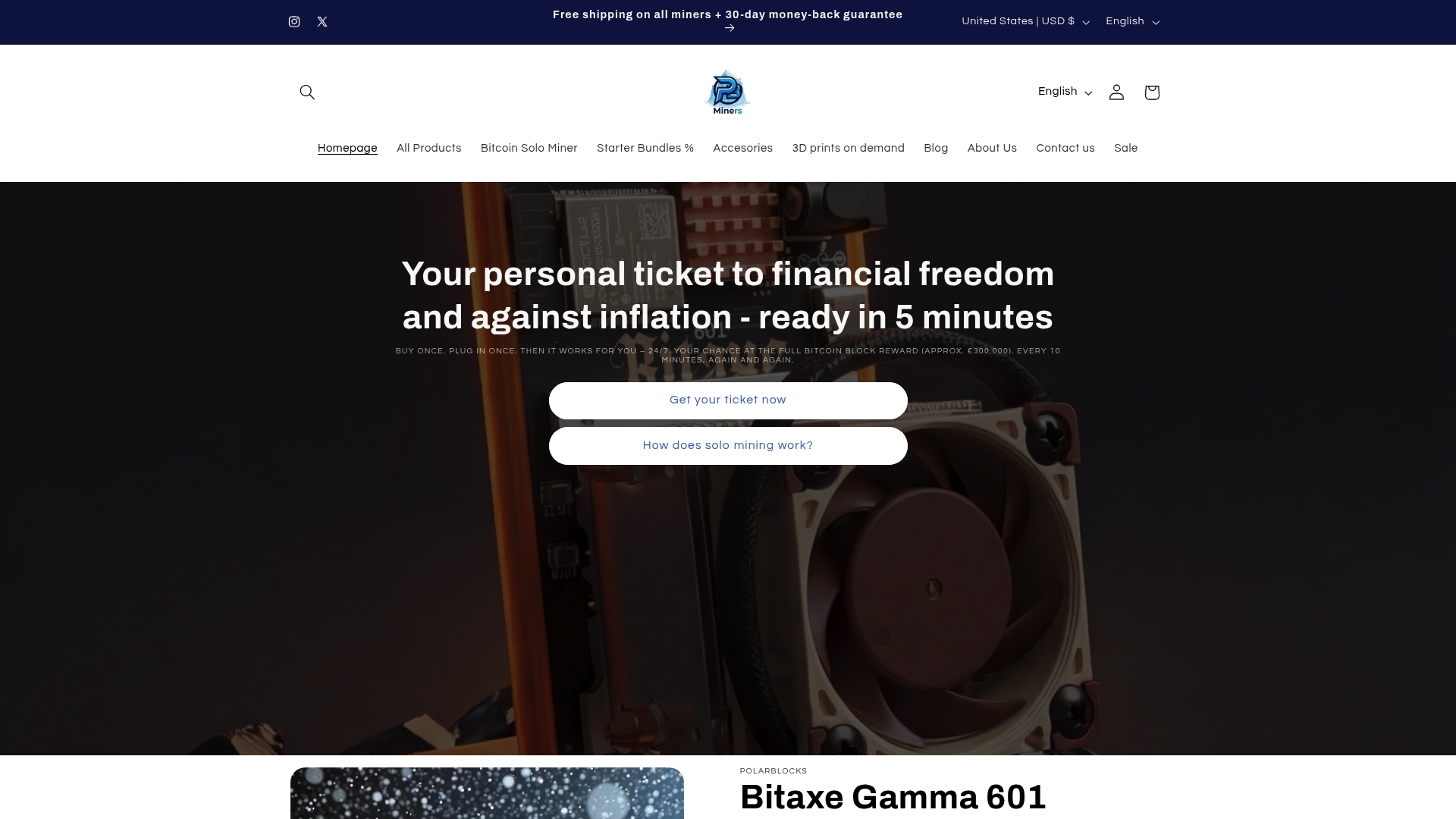
Polarblocks offers exactly that. Every miner is hand-assembled, tested, and configured in Bavaria. No plastic casing from the Far East, no anonymous provider. Made in Germany, with a 30-day money-back guarantee. The Bitcoin Solo Miner models from Polarblocks are plug-and-play, quiet, and designed for continuous operation. If you want to start with a compact entry-level device, the NMminer TV 1 MH/s is a solid option. For premium hardware and the entire range, it's worth checking out polarblocklabs.com.
Frequently Asked Questions About Solo Mining
Is solo mining legal in Germany?
Solo mining is legal in Germany.
How do solo mining and cloud mining differ in terms of scam risk?
Solo mining carries hardly any scam risk, as you own and operate your hardware yourself, while cloud mining is often opaque and susceptible to dubious providers.
Is solo mining financially worthwhile for private users?
Solo mining is usually only worthwhile with low electricity costs below 0.12 Euro per kWh and offers you the full chance of decentralized block rewards.
What is the probability of actually finding a Bitcoin block as a solo miner?
The chance is often 1:100,000 depending on the hardware, but individual private users have already achieved surprising successes. Over the year, the chances increase significantly (up to 1:8000 due to approx. 52,560 attempts per year!).
Why are guaranteed returns in mining dubious?
Bitcoin mining has no guaranteed income because block discovery is random. Any provider promising fixed daily returns is either operating a Ponzi scheme or misrepresenting the actual computing power.


