

Solo Mining 2026: How to win independent Bitcoin block rewards
TL;DR: Solo mining offers the chance for a full block reward with low operating costs. It requires a special solo miner. Although the probability of winning is low, it contributes to the decentralization of Bitcoin and is like winning the lottery if successful.
In 2026, various private solo Bitcoin mining enthusiasts with small setups won a complete block on the Bitcoin network and pocketed about $222,000. That sounds like a one-off statistical lucky shot. But it's a real, documented event that shows: solo mining is not pure fantasy. In this guide, you'll learn what solo mining technically means, what hardware and software you need, how realistic your own block reward chances are, and how to get started sustainably and independently.
Table of Contents
- Solo Mining: Basics and Distinction from Pool Mining
- Technical Requirements and Sustainable Setup for Solo Mining
- Opportunities, Risks, and Experiences: Solo Miners 2026 in Numbers
- Solo Mining in Practice: Tips for Your Start and Sustainable Success
- Solo Mining: What Really Matters – Our Perspective
- Ready for Your Solo Mining Adventure? Find the Right Hardware
- Frequently Asked Questions about Solo Mining
Key Takeaways
| Point | Details |
|---|---|
| Solo Mining means personal responsibility | You have complete control and, if successful, receive the entire reward yourself. |
| Sustainability pays off | By using renewable energy and good hardware, solo mining becomes more economical and future-proof. |
| Irregular but high profits possible | Even low hashrate can occasionally bring the large block reward, as examples from 2026 show. |
| Technical know-how is required | Anyone who wants to successfully operate solo mining should be familiar with hardware, security, and networks. |
Solo Mining: Basics and Distinction from Pool Mining
Solo mining means: You operate your own hardware, connect it directly to the Bitcoin network, and try to solve the next block alone. There's no pool, no shared hash power, no proportionate small monthly block reward payments. You work on your own account. Solo mining operators receive the entire 3.125 BTC plus all included transaction fees if they find a block.
Pool mining works differently. You join thousands of other miners, share the combined hash power, and receive proportionate small payments, depending on your work contributed. That sounds more stable. But it's also less sovereign: You give up control, pay pool fees, and share every profit.
Solo mining is not a gamble against the system. It is the most original form of Bitcoin mining: you, your hardware, and the network.
Solo Mining vs. Pool Mining at a glance:
| Criterion | Solo Mining | Pool Mining |
|---|---|---|
| Block Reward | 100% if successful | Proportionate, regular |
| Risk | High, irregular | Low, predictable |
| Privacy | Maximum | Limited |
| Fees | None | 1-3% pool fee |
| Control | Complete | Delegated |
Which method is suitable for which users?
- Solo Mining: Users who prefer independence and the chance for the full block reward
- Pool Mining: Users who desire regular small payouts and predictability
- Independent mining is particularly attractive for anyone who wants to actively decentralize the Bitcoin network
Another comparison between solo and pool mining shows that both approaches have their merits. The decision depends on your goals, risk tolerance, and technical interest.
Technical Requirements and Sustainable Setup for Solo Mining
Now that the basics are clear, let's move on to concrete implementation. A complete solo mining setup consists of three parts: a Bitcoin full node, suitable mining hardware, and appropriate mining software.
Recommended hardware by experience level:
| Hardware | Hash Power | Consumption | Target Group |
|---|---|---|---|
| NerdAxe/Bitaxe | 500 GH/s to 4 TH/s | 15-21 W | Beginners |
| Antminer S21 Pro | up to 234 TH/s | approx. 3500 W | Advanced |
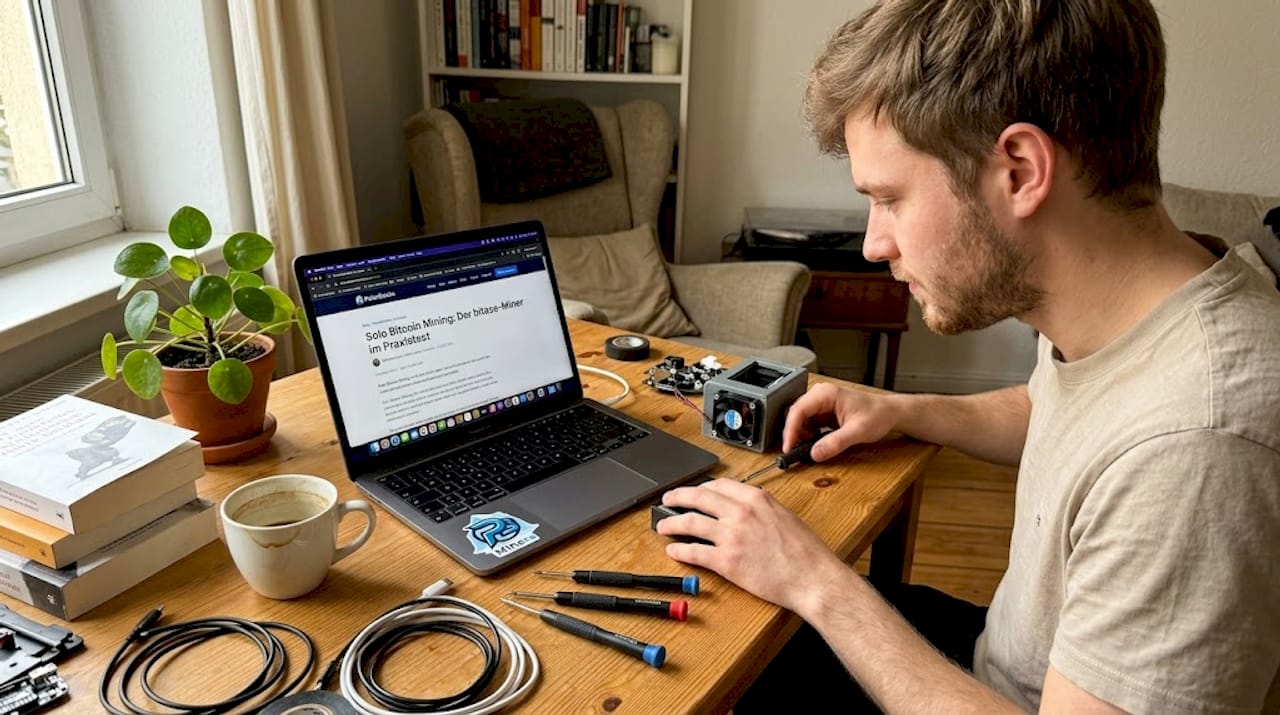
For beginners, the Bitaxe or NerdAxe is the best choice. Consumption is about 15 to 21 watts, similar to an LED light bulb. This makes operation financially manageable. The efficiency of solo mining directly depends on how cheap your electricity is and how stable your setup runs.
Software options include Bitcoin Core (for the full node), CGMiner or BFGMiner, and solo pools like CKPool. CKPool is particularly interesting: It forwards your hash power directly to the Bitcoin network, without proportionate payouts. You keep 100% of the block reward if you find one.
Step-by-step checklist for a sustainable setup:
- Choose suitable mining hardware (Bitaxe for beginners)
- Configure mining software and connect to CKPool
- Check power source
- Regularly monitor hardware for temperature and hashrate
- Protect hardware sustainably through good ventilation and a clean environment
Pro tip: Mining with solar power is one of the most effective methods to reduce operating costs to almost zero. A small solar panel on the balcony can be enough to continuously operate a Bitaxe. This makes solo mining not only cheaper but also significantly more sustainable. Hardware recycling at the end of its lifespan is another aspect that responsible miners should consider.
Opportunities, Risks, and Experiences: Solo Miners 2026 in Numbers
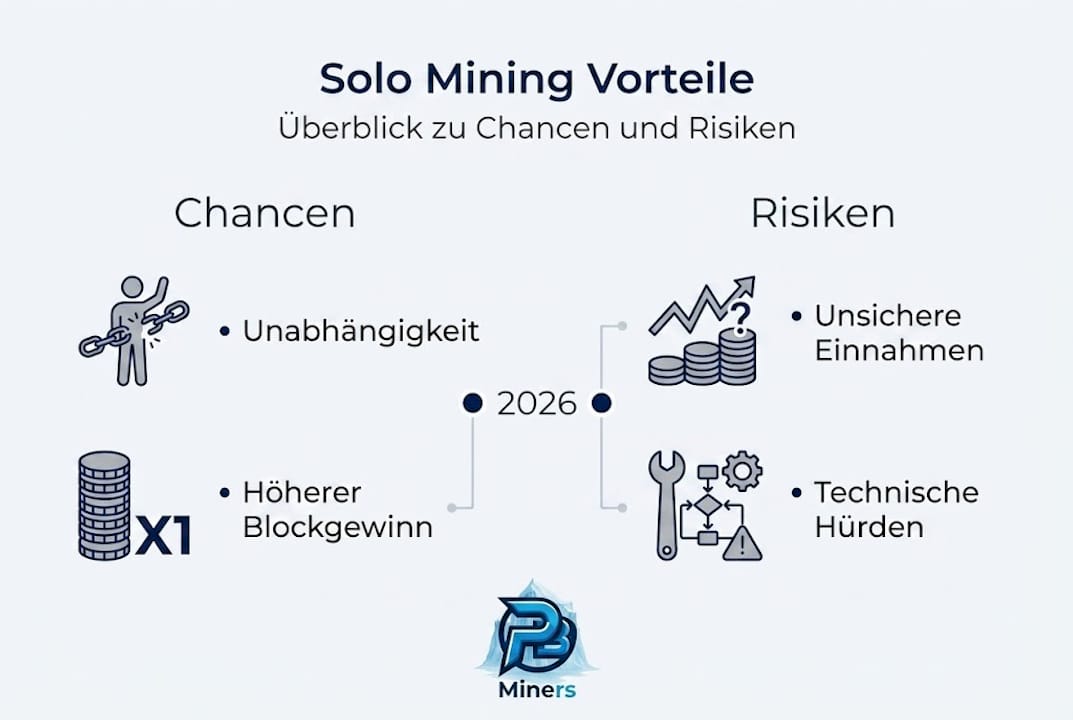
With knowledge of the basics and setup, it's worth looking at real numbers. A Bitaxe has about a 1:10000 chance.
That sounds low. But it is a real chance. The mining community regularly documents similar successes, especially through CKPool statistics.
What private miners can realistically expect:
- No regular income, no guaranteed payouts
- In case of a block find: 3.125 BTC plus transaction fees, 100% for you
- Ongoing operating costs: mainly electricity, very low with efficient hardware
- Learning effect: deep understanding of Bitcoin technology, network security, and mining processes
- Decentralization contribution: every solo miner strengthens the Bitcoin network
Solo mining is like a lottery ticket you print yourself, runs 24/7, and strengthens the decentralized foundation of Bitcoin.
Risk comparison at a glance:
| Factor | Solo Mining | Pool Mining |
|---|---|---|
| Income regularity | None | High |
| Maximum single gain | 3.125 BTC + fees | Proportionately small |
| Network contribution | Direct, decentralized | Indirect |
| Learning curve | Steep, educational | Flat |
The current mining trends show: more and more private users are consciously opting for solo mining, not because they hope for quick riches, but because they value control and the learning effect. A comparison of solo and pool mining emphasizes: those who think long-term and are willing to wait for the jackpot are well-served by the solo approach. Hardware maintenance is often an underestimated factor for long-term success.
Solo Mining in Practice: Tips for Your Start and Sustainable Success
Based on the opportunities and risks, it's clear: solo mining is not a sprint. It's a marathon. Solo mining is particularly suitable for tech-savvy users with access to cheap or green energy as a low-risk experiment with a real jackpot chance.
Your entry into solo mining: step by step:
- Educate yourself on the basics of Bitcoin and mining (Full Node, Hash Power, Block Reward)
- Choose your first hardware: Bitaxe or NerdAxe for beginners
- Connect your hardware directly to the Bitcoin network via CKPool
- Monitor hashrate and temperature daily in the first few weeks
- Optimize your electricity consumption through solar power or cheap tariffs
Pro tip: start small and experiment. A single Bitaxe costs little, consumes minimal power, and gives you all the fundamental experience. You learn how the Bitcoin network really works, and you have a new chance at the block reward every 10 minutes. That's not a bad deal.
Typical mistakes and how to avoid them:
- Too high expectations: Solo mining is not a source of income, but an opportunity
- Incorrect hardware sizing: Starting with an Antminer S21 Pro without checking electricity costs
- Lack of monitoring: Hardware overheats and fails because no one is watching
- No full node: Without your own node, you give up control
- Impatience: Those who give up after 3 months might miss the block in the fourth
Staying motivated is not a matter of willpower. It's a matter of perspective. Solo miners for beginners show: those who understand mining as a learning project and a contribution to decentralization will stick with it in the long run. The jackpot is the bonus, not the goal.
Solo Mining: What Really Matters – Our Perspective
The standard advice is: "Join a pool, you'll earn regularly there." That's true. But it's too short-sighted. Pool mining makes you dependent on third parties, costs fees, and contributes to the centralization of the Bitcoin network. This contradicts the fundamental idea of Bitcoin.
Solo mining with renewable energies is the opposite. You learn how the network truly works. You strengthen decentralization. You have a real, albeit rare, chance for more independence in mining and financial self-determination. The learning effect alone is worth getting started. The possible jackpot is what motivates you to turn on your miner in the morning.
Pro tip: weigh the risks carefully. Solo mining is not an investment in the traditional sense. It's an experiment with a real chance, real educational value, and a direct contribution to Bitcoin's security.
Ready for Your Solo Mining Adventure? Find the Right Hardware
Solo mining requires the right hardware. Getting started doesn't have to be expensive or complicated.
At Bitcoin solo miners from polarblocks, you'll find starter packages that are already configured, tested, and ready to go. You don't have to be a programmer. You plug it in, connect to the network, and your miner works for you immediately. All information about solo mining will help you find the right device for your home. The next block could be yours.
Frequently Asked Questions About Solo Mining
What is the current probability of winning with solo mining?
The chance depends on your hash power. With 1.3 TH/s, it's about 1:10000 per year.
Do I need special hardware for solo mining?
Yes. NerdAxe or Bitaxe from 1.3 TH/s are ideal for beginners, while the Antminer S21 Pro is suitable for users with a higher budget and more hash power.
Can I also earn transaction fees with solo mining?
Yes. Solo miners receive the full block reward plus all transaction fees from the transactions included in the block, without deductions.


