

Independent Mining: More Control and Sustainability
TL;DR:
- Small solo miners were able to win complete Bitcoin blocks in 2025, proving independence in mining. Autonomous mining promotes decentralization, control, and protects against censorship. With efficient hardware and renewable energy, home mining is economically and sustainably possible.
In 2025, small solo miners with minimal computing power managed to win complete Bitcoin blocks. Via CKPool, 13 solo blocks were found by private individuals, although the statistical daily chance is 1:4,700,000. This sounds like a lottery game, and that's precisely the point: independent mining is not a myth. It's a real option for anyone who wants to take control of their contribution to the Bitcoin network. Those who forgo large farms and centralized pools not only gain independence but actively strengthen the decentralization of the entire network. For private users in Germany, this is more relevant than ever.
Table of Contents
- What Does Independent Mining Mean and Why Is It Important?
- How Does Independent Mining Work Technically at Home?
- Comparison: Independent Mining vs. Mining Pools and Large Farms
- Sustainable Home Mining: Economic Viability and Energy Use
- What Most People Overlook: Why Independent Mining Is More Than a Trend
- Your Next Step: Efficient Mining Hardware for Home Use
- Frequently Asked Questions about Independent Mining
Key Takeaways
| Point | Details |
|---|---|
| Solo mining creates independence | Own node and hardware give private users control over mining and earnings. |
| Sustainability makes the difference | With renewable energies or the use of surplus electricity, mining becomes more environmentally friendly and economical. |
| Decentralization protects the network | Many independent home miners keep Bitcoin resilient against centralization and regulation. |
| Technically easy to implement | With compact, efficient miners and basic knowledge, starting independent mining is feasible. |
What Does Independent Mining Mean and Why Is It Important?
Now that it's clear that independence in mining is truly possible, let's understand what this specifically means and what advantages it offers.
Solo mining means: You operate your own miner, connected to your own Bitcoin node, without intermediaries. No pool fees, no external infrastructure, no dependence on third parties. If you find a block, you receive the full block reward of 3.125 BTC plus all transaction fees directly into your own wallet. This is a fundamental difference from pool mining, where profits are shared and fees are deducted.
The social dimension is often underestimated. Bitcoin thrives on its decentralization. The more independent miners participate in the network, the harder it becomes for individual actors to control the network or censor transactions. Large mining pools, on the other hand, concentrate computing power in a few hands, which poses a real risk to network security.
The most important advantages of independent mining at a glance:
- Full control: You decide which transactions to include in your block.
- No pool fees: Every satoshi of the reward belongs to you.
- Transparency: You see every step of the process directly.
- Censorship resistance: No pool can block your transactions.
- Contribution to decentralization: Every home miner strengthens the network.
“Independent Bitcoin mining gives you full control, no fees, and the entire block reward if successful. It's the most direct contribution to decentralization an individual can make.”
Of course, there are also risks. You bear the costs for hardware and electricity yourself, without guaranteed income. The risk is real, but manageable if you choose the right equipment. If you want to learn more about the basics, our Solo Mining Explained article provides a solid introduction. The key is to keep your expectations realistic and understand mining as a long-term commitment, not a quick profit.
How Does Independent Mining Work Technically at Home?
If you know why independence in mining is important, the question arises of how it works in practice.
The heart of any true solo mining setup is your own Bitcoin node. It downloads current block data, validates transactions, and connects to the network via the getblocktemplate protocol. Your miner queries this node for a task, calculates hashes, and reports a hit if it finds a valid block. Without your own node, you are technically not a true solo miner but dependent on an external service.
The typical setup for home users looks like this:
- Set up a Bitcoin Node: A Raspberry Pi or an old PC is sufficient to run a full node.
- Connect the Miner: Compact devices like Bitaxe or compact mining hardware connect to the node via Wi-Fi or Ethernet.
- Configure the Software: The miner software is set to your own node address.
- Ensure Continuous Operation: Stable power supply and internet connection are mandatory.
- Set up Monitoring: Dashboards show hashrate, temperature, and operating hours in real-time.
One important aspect that many beginners underestimate: every hash attempt is completely independent of the previous one. The network has no memory. A lucky block, despite low odds, is always possible, no matter how long you've been mining. This makes solo mining a true lottery game with unchangeable mathematics.
Pro tip: If you run your node on a power-saving device like a Raspberry Pi 4, it costs less than 5 euros per month in electricity. The effort for setup is worth it because you gain true independence and pay no fees to third parties.
The entry barrier is significantly lower today than it was a few years ago. Modern Bitaxe miners are plug-and-play, well-documented, and supported by an active community. Anyone willing to invest an afternoon in setting it up will have a fully autonomous mining operation afterwards.
Comparison: Independent Mining vs. Mining Pools and Large Farms
Now that we understand the technical basis, let's look at the different mining models and their effects.
| Feature | Solo Mining | Pool Mining | Industrial Farm |
|---|---|---|---|
| Block Reward | 100% on success | Proportional, minus fees | Proportional, internally distributed |
| Fees | None | 1 to 3% | None (internal) |
| Decentralization | Maximum | Low | Minimal |
| Income Regularity | Irregular | Regular | Regular |
| Censorship Resistance | High | Low | Very low |
| Initial Costs | Low | Low | Very high |
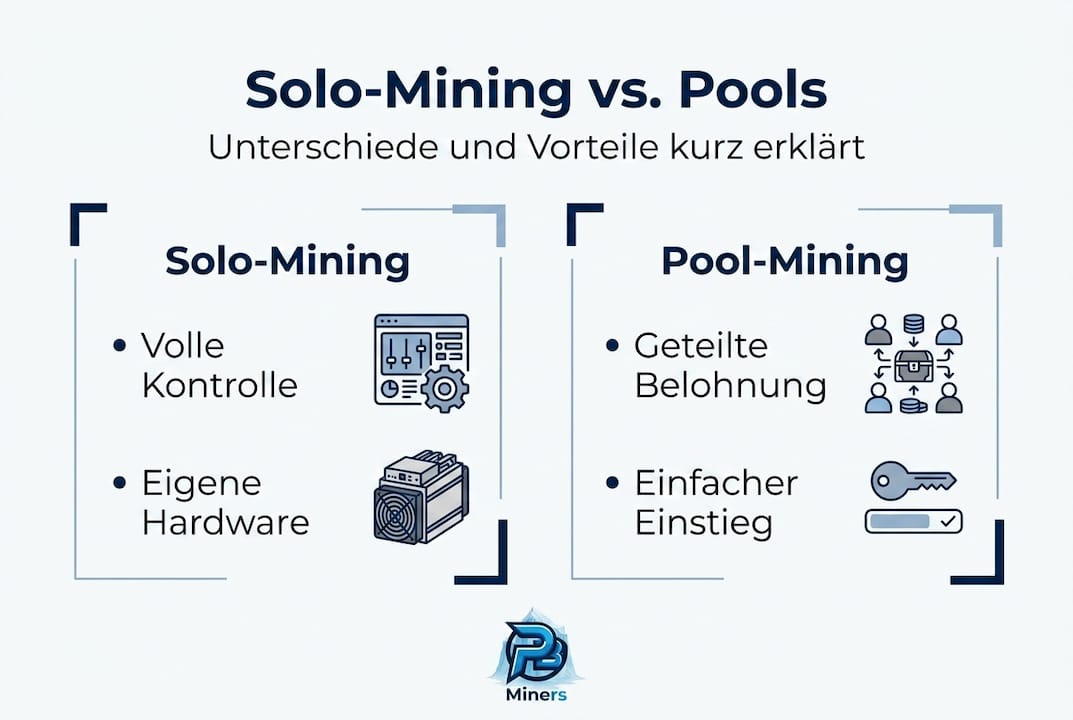
The table shows: Solo mining is not a competing model to pools, but a fundamentally different concept. It's not about achieving the highest regular income, but about independence and contributing to network health.
The current market development is particularly interesting. Many large mining companies are switching to AI infrastructure. 40% of the hashrate is affected by this pivot, which led to a 7.76% decrease in difficulty in 2026. This significantly improves the chances for small, independent miners.
While pools bundle computing power and are therefore theoretically more effective, they also create points of attack. A pool with over 50% of the network hashrate could theoretically censor transactions or manipulate blocks. This risk is not hypothetical but has been discussed multiple times in Bitcoin's history.
The advantages of small miners in the current situation:
- Decreasing difficulty increases the relative chance of success.
- Less competition from migrating large farms.
- 13 solo blocks in 2025 prove that hits actually happen.
- Low operating costs make continuous operation economically viable.
Those who understand the advantages and risks of solo mining can make an informed decision. The AI pivot in the industry is a real opportunity for home users that can be seized now.
Sustainable Home Mining: Economic Viability and Energy Use
Beyond pure technology, sustainability and economic viability are particularly important for private users.
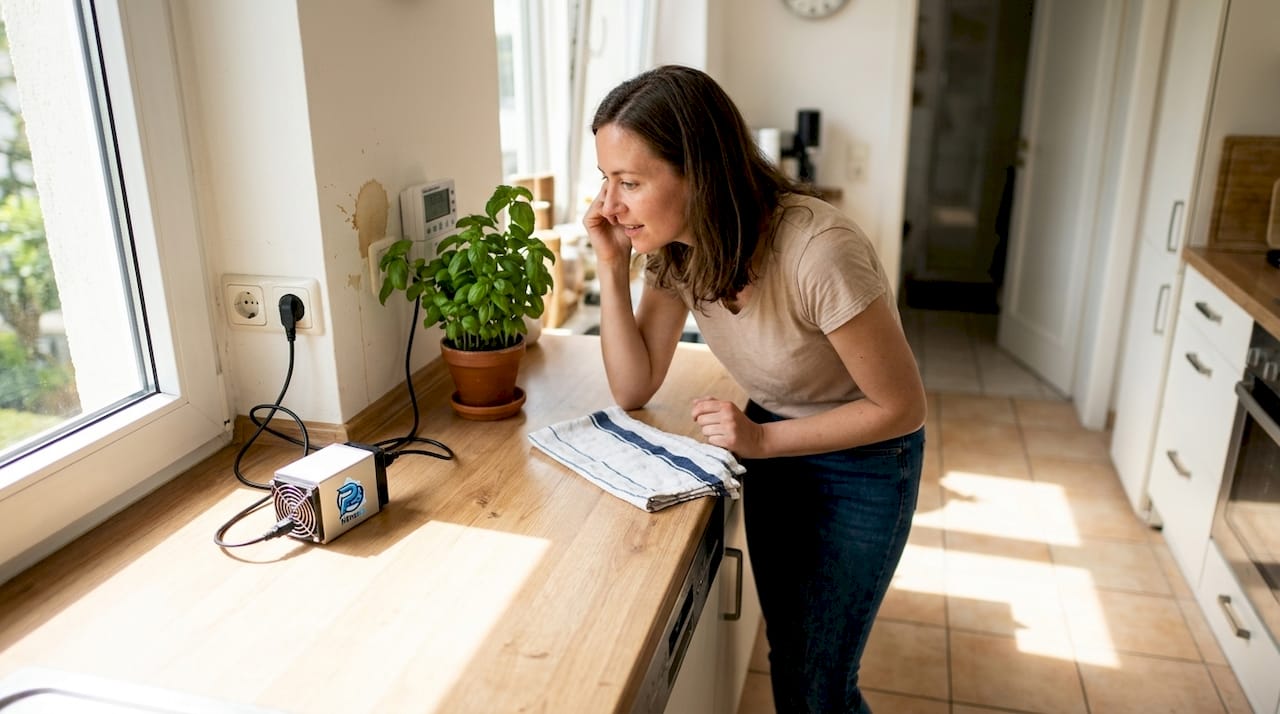
Germany has one of the highest electricity prices in Europe. This might initially sound like a disadvantage for mining. However, those who operate a photovoltaic system can utilize surplus electricity that would otherwise be fed into the grid or wasted. An efficient home miner with 20 to 25 watts of consumption costs only 0.15 to 0.21 euros per day at an electricity price of 0.35 euros per kWh.
| Scenario | Consumption | Daily Cost | Monthly Cost |
|---|---|---|---|
| Grid Power (0.35€/kWh) | 25W | 0.21€ | 6.30€ |
| PV Surplus (0.05€/kWh) | 25W | 0.03€ | 0.90€ |
| Night Tariff (0.22€/kWh) | 25W | 0.13€ | 3.90€ |
The figures show that with your own solar power, operating costs drop to a minimum. At the same time, the miner contributes to society as a flexible load for grid stabilization. Curtailment costs of 3.1 billion euros in 2025 show how much surplus electricity remains unused in Germany.
Pro tip: Those who register their miner as a controllable load with the grid operator according to §14a EnWG can benefit from reduced network charges. Dimming the power in case of grid bottlenecks is technically easy to implement and saves real money.
Another advantage rarely mentioned: waste heat. A 25-watt miner continuously produces heat that can be used as a supplement to heating in colder months. This may sound like a minor detail but genuinely reduces heating costs.
The most important points for sustainable home mining:
- Utilize PV surplus: Electricity that would otherwise be lost works for you.
- Plan for waste heat: A real added value, especially in winter.
- Calculate continuous operation: Low wattage makes 24/7 operation economically viable.
- Know the regulations: §14a EnWG offers savings potential for smart users.
What Most People Overlook: Why Independent Mining Is More Than a Trend
Most reports on Bitcoin mining focus on hashrate, difficulty, and profitability. What's often missing: the democratic impact of thousands of small, independent miners.
Solo mining not only strengthens the network's security but also its resilience against political and economic influence. A network supported by many small actors is harder to attack than one dominated by ten large farms. The AI pivot in the industry is not a setback for Bitcoin but an opportunity. It opens space for precisely those home users who should support the network long-term.
Combining waste heat, renewable energy, and independence creates a mining setup that does more than just calculate hashes. It's a statement for a decentralized future. The long-term impact of solo mining on the network is systematically underestimated by media and analysts. Every home miner counts, even if they never find a block.
Your Next Step: Efficient Mining Hardware for Home Use
If you're now curious about the first steps in independent home mining, you can find suitable hardware solutions directly from us. At PolarBlock Labs, we develop and manufacture quiet, energy-efficient miners specifically for home use, handcrafted in Germany and calibrated for maximum efficiency.
Our discover Bitaxe Miners and proven compact mining hardware purchase options offer you a direct entry into solo mining without compromising on noise or energy consumption. Whether you want to use surplus electricity from your PV system or simply mine independently of large-scale operations, we have the right solution for your home.
Frequently Asked Questions about Independent Mining
What Are the Realistic Chances of Finding a Block as a Solo Miner?
The daily probability at a performance of 1.2 TH/s is 1:4,700,000, but individual lucky hits happen regularly, as shown by the 13 solo blocks found in 2025. Solo mining is therefore aptly known as Lottery Mining.
Is Mining Profitable with Current Electricity Prices in Germany?
With an energy-efficient miner and your own PV electricity, daily costs drop to less than 0.05 euros, making continuous operation economically viable. Surplus electricity, which would otherwise remain unused, is thus put to productive use.
Do I Need Expertise to Mine Independently?
Beginners with a basic technical understanding can start with good instructions, as modern miners are plug-and-play and the basics of solo mining are well-documented. Setting up your own node often takes less than half a day.
Which Hardware is Particularly Suitable for Quiet and Efficient Solo Mining?
Devices like Bitaxe Gamma or NMminer consume only 20 to 25 watts and operate almost silently, making them ideal for continuous operation in living areas. They are specifically designed for home use and easy to configure.


