

Bitaxe Miner Explained: Efficient Bitcoin Solo Mining
TL;DR:
- The Bitaxe Miner is a small, energy-efficient open-source device for solo mining at home, which can be operated independently and sustainably. It allows private users to mine directly against the Bitcoin network and earn actual block rewards. Despite the low probability, users have successfully found multiple blocks with this miner since 2024.
Anyone who says Bitcoin mining is only for huge data centers has not yet encountered a small but powerful counter-argument: the Bitaxe Miner. Millions of euros worth of equipment, noisy server farms in Iceland or Texas, thousands of kilowatts of electricity consumption. That's the image most people have in mind. But the truth is different. A Bitaxe Miner consumes as much power as an LED light bulb and gives you the chance to win 3.125 BTC every 10 minutes. Real private users have found at least four blocks this way since 2024. This article explains how this is possible, what Bitaxe Miners technically achieve, and how you can get started with your own.
Table of Contents
- Fundamentals of Bitaxe Miners and Bitcoin Solo Mining
- Technical Performance Data and Hardware Factors at a Glance
- Solo vs. Pool Mining: Comparison and Practical Tips for Private Users
- Everyday Life with Bitaxe Miner: Setup, Maintenance, and Chances of Success
- My Perspective: Why Solo Mining with Bitaxe is More Than Just a Hobby
- Discover Bitaxe Miners and Solutions for Private Users
- Frequently Asked Questions about Bitaxe Miner
Key Takeaways
| Point | Details |
|---|---|
| Solo Mining as a Lottery | Bitaxe Miners offer the chance for real jackpots, but participation remains speculative. |
| Efficient and Sustainable | With low power consumption and an open-source design, Bitaxe devices are ideal for home hobbyists. |
| Technology is Crucial | Power supply, fan, and stable hardware are essential for flawless operation. |
| Pool vs. Solo Mining | Pool mining ensures small returns, solo mining brings excitement and maximum influence. |
| Sovereignty through Own Setup | Using Bitaxe with your own node increases control and independence in mining. |
Fundamentals of Bitaxe Miners and Bitcoin Solo Mining
A Bitaxe Miner is a small, open-source mining device specifically designed for home use. Unlike industrial ASIC (Application-Specific Integrated Circuit) machines, which consume several kilowatts and are as loud as a vacuum cleaner, a Bitaxe fits on any desk. It is based on the BM1368 chip, also used in professional miners, but operated in a significantly more energy-efficient configuration.
The open-source design is no accident but a philosophy. Anyone can view, review, and improve the code. This creates trust because no hidden backdoors or opaque firmware are possible. This is precisely what distinguishes Bitaxe from many commercial solutions that keep their software behind closed doors.
Solo Mining means: You mine directly against the entire Bitcoin network, without a pool. If you find a block, the entire block reward, currently 3.125 BTC, is 100% yours.
Why do this at all? Sustainable solo mining at home combines low operating costs, open-source transparency, and a real contribution to the decentralization of the Bitcoin network. It's not primarily about achieving consistent monthly returns. It's about sovereignty, the feeling of actively participating in the network, and the lottery chance of financial freedom.
For those aiming for hardware sovereignty with a desk miner, the Bitaxe is the ideal tool: compact, quiet, transparent, and without dependence on third parties. The idea of independent mining and sustainability runs through the entire Bitaxe community, making this movement more than just a tech hobby.
Technical Performance Data and Hardware Factors at a Glance
What does a Bitaxe Miner really achieve? Here are some concrete figures.
| Parameter | Standard Operation | With Upgrade (Noctua Fan) | Overclocking |
|---|---|---|---|
| Hashrate | 1.2 TH/s | 1.2 TH/s (more stable) | 1.4 to 2.0 TH/s |
| Power Consumption | approx. 15 W | approx. 15 W | 18 to 25 W |
| Error Rate | low | low | approx. 20 % |
| Warranty | available | available | mostly void |
| Noise Level | quiet | very quiet | quiet to moderate |
In the long-term test of the Bitaxe 601 Gamma, it becomes clear: 1.2 TH/s at 15 watts consumption is the stable standard value. With an upgrade to a Noctua fan, the device does not run faster, but more thermally balanced and quieter. This is particularly relevant if the miner runs permanently in a home office.
The topic of overclocking sparks lively discussions in the community. Overclocking up to 2 TH/s is technically possible, but comes with an error rate of around 20% and voids the warranty. Those who play it safe leave the miner in standard mode. The hashrate is lower, but the hardware lasts longer and runs more stably.
Pro Tip: For your Bitaxe Miner, use a high-quality power supply with at least 5 volts and 6 amps output. Cheap power supplies fluctuate in voltage and can make the hashrate unstable or, in the worst case, damage the hardware. A stable power supply is the cheapest insurance for your miner.
The Solo Mining Revolution in the Home Office is based precisely on these values: 15 watts is less than many chargers consume. If you also use a photovoltaic system or have a cheap electricity tariff, you can further reduce operating costs. You can find more about this in the article on mining with heating and PV.
Solo vs. Pool Mining: Comparison and Practical Tips for Private Users
Now comes the crucial question: solo mining or pool mining? Both approaches have their place, but for different goals.
| Criterion | Solo Mining | Pool Mining |
|---|---|---|
| Return Stability | very low (lottery) | regular, but minimal |
| Maximum Return | 3.125 BTC (one-time) | Fractions of Satoshi daily |
| Network Control | complete | none |
| Fees | none | 1 to 3 % pool fee |
| Excitement and Fun Factor | very high | low |
| Decentralization Contribution | strong | low |
Pool mining provides small, predictable returns. This sounds secure, but it is relatively: With the hashrate of a Bitaxe Miner, the daily returns in the pool are so low that they hardly cover electricity costs. Real jackpots are rare, but documented. Solo mining is the strategy for anyone who wants the full block reward and enjoys the lottery excitement.
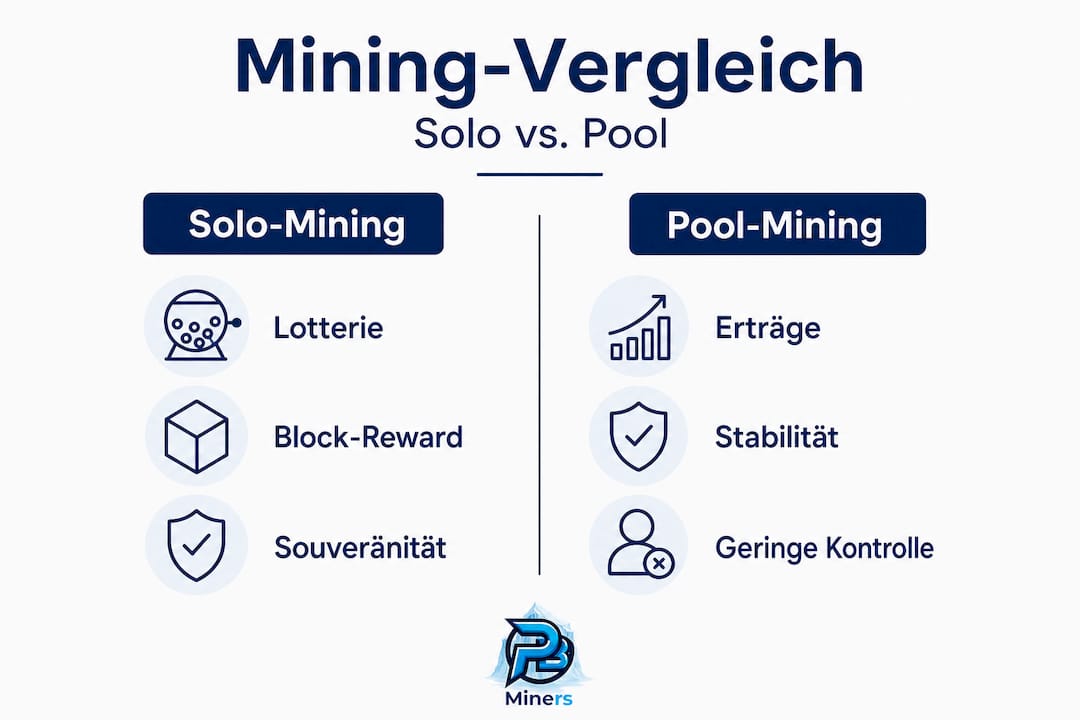
The smartest option: Solo mining with your own Bitcoin node. This allows you to verify transactions yourself, be independent of any third-party provider, and strengthen the entire network. This is the maximum level of sovereignty.
How to get started with solo mining:
- Choose a Bitaxe Miner and order it with pre-configured firmware.
- Connect the miner to your router via LAN or WLAN.
- Configure the mining software via the web interface (no programming knowledge required).
- Select the solo mining pool (e.g., ckPool) as the target server.
- Enter your Bitcoin wallet address. This is the address to which a found block will be paid.
- Let the miner run and monitor your statistics on the dashboard.
Pro Tip: Run your own Bitcoin full node and connect your Bitaxe Miner directly to it. Then you are truly independent. You verify blocks yourself and don't need an external pool server.
Those who aim for security through sustainable mining recognize: The real value lies not only in the potential block reward but also in independence from the financial system. You can find more about passive income with mining in our detailed article.
Everyday Life with Bitaxe Miner: Setup, Maintenance, and Chances of Success
Everyday life with a Bitaxe Miner is surprisingly relaxed. No constant repairs, no overheating, no noisy fans. Nevertheless, there are a few things you should pay attention to.
Setup Checklist for Getting Started:
- Provide a high-quality power supply with at least 5V/6A
- Place the Bitaxe Miner in a well-ventilated area
- Prefer a wired network cable (more stable than WLAN)
- Check the firmware version and update if necessary
- Carefully enter the mining target address (no typos!)
- Check the dashboard daily to ensure hashrate is stable
For maintenance: A Bitaxe Miner requires little care. Occasional dusting of the fan every few months is sufficient. The most common source of error is an unstable power supply. This again emphasizes why a good power supply is not an option, but a necessity.
Regarding the chances of success, it's important to remain realistic. The statistical probability of finding a block is about 1:4,700,000 per day. That sounds small. But: Since 2024, private users with Bitaxe devices have found at least four blocks, including blocks #853742, #887212, and #924569. Someone wins this lottery. Why not you?
Fact: 1.2 TH/s equals 1,200,000,000,000 calculations per second. Your small desk miner works for you around the clock.
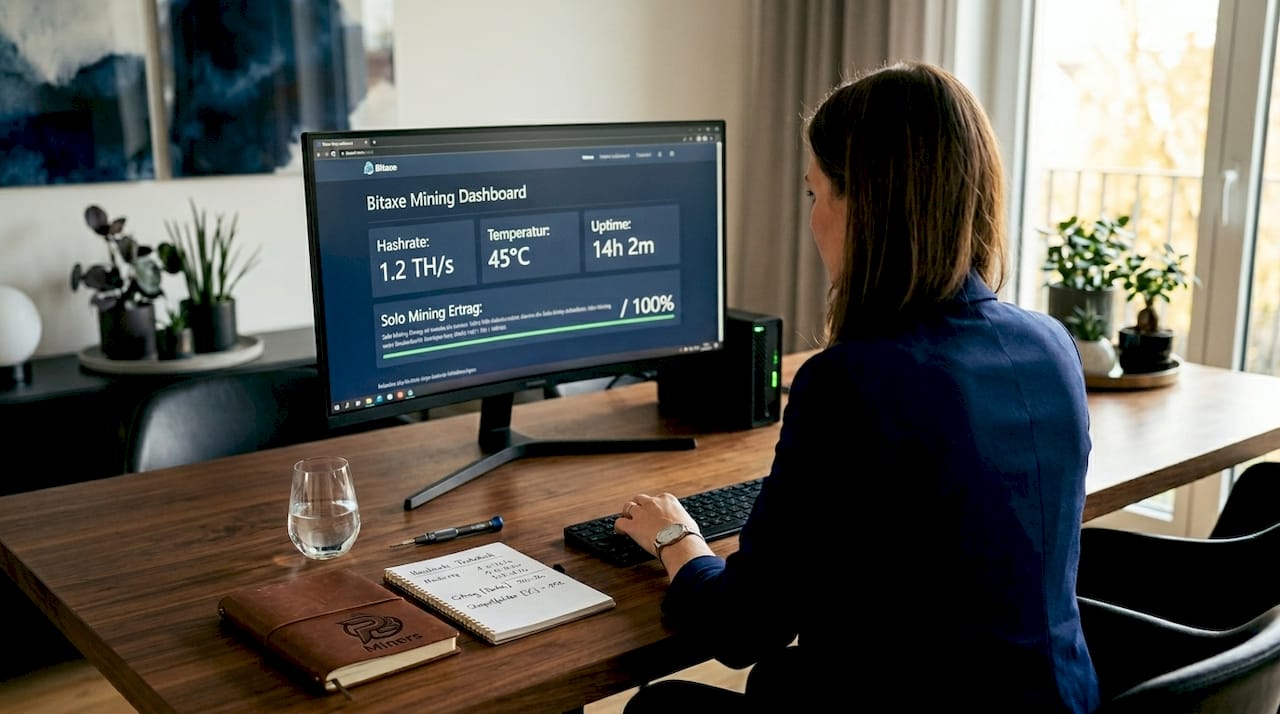
The beauty of it: You watch the miner at work. The dashboard shows hashrate, shares found, and connection quality in real-time. Some users report that watching the dashboard is almost meditative. For anyone pursuing financial freedom as a real goal, the Bitaxe Miner is the most tangible first step.
My Perspective: Why Solo Mining with Bitaxe is More Than Just a Hobby
Many guides on the internet calculate the profitability of mining hardware and conclude: "It's not worth it." This is a superficial view. It forgets what Bitaxe is really about.
We at Polarblocks see things differently. The Bitaxe Miner is not an investment instrument in the classical sense. It is a statement. It says: "I trust no bank, no pool, no intermediary. I do Bitcoin myself." This is exactly what Bitcoin originally meant. Decentralization is not an abstract idea. It happens when thousands of Bitaxe Miners run in thousands of home offices.
The community aspect is systematically underestimated here. Open source means that every improvement to the firmware benefits everyone. If a developer in Australia writes a more stable driver, you in Munich benefit from it. This is peer technology in its purest form. Sovereignty in mining does not arise from isolation, but from mutual strengthening.
What common advice systematically misses: the fun factor. It's genuinely fun to watch a miner run. The excitement that a new block is decided every 10 minutes and you are part of it is unique. This emotional dimension distinguishes solo mining from any ETF savings plan. The revolution in home office mining is also a cultural movement. And cultural movements change the world.
Discover Bitaxe Miners and Solutions for Private Users
Do you want to get your own Bitaxe Miner up and running? At Polarblocks, you'll find pre-configured hardware, hand-assembled in Germany, that runs straight out of the box. No programming, no guesswork. Our ultimate guide to solo mining, inflation protection, and financial sovereignty explains every step from zero to a running miner. If you prefer a structured introduction, you'll find everything you need in our Home Miner Guide. Start today. The next lottery is already underway.
Frequently Asked Questions about Bitaxe Miner
What is the real probability of finding a Bitcoin block with Bitaxe solo mining?
The statistical chance is 1:4,700,000 per day, but real private users have successfully found at least four blocks since 2024.
Can I also run pool mining with Bitaxe Miner, and is it sensible?
Pool mining is technically possible, but pool returns at this hashrate are so low that the effort is hardly worth it. Solo mining remains the more exciting choice for hobbyists.
What are the most important hardware requirements for Bitaxe Miner in solo operation?
A stable power supply with at least 5V/6A is essential, supplemented by good cooling and optionally a fan upgrade for quieter continuous operation.
Is Bitaxe mining financially worthwhile, or is the fun factor paramount?
Solo mining stands for independence and fun, not for constant returns. Those who see the potential block reward as a jackpot are approaching it with the right expectations.
Recommendation
- Solo Mining Revolution: How 15 Watts in the Home Office Challenges the Industry – Polarblocks
- Bitcoin Mining with Heating & PV: How to Save with Tibber – Polarblocks
- Bitaxe Mining Security: Your Self-Sufficient Home Office Setup – Polarblocks
- Hardware Sovereignty 2026: Desktop Miners as a Stock Market Alternative – Polarblocks


