
Why Open Source Mining Frees Solo Bitcoin Mining
Investigative Market Analysis by Polarblocks Editorial Team · Reading time approx. 12 minutes · Updated May 14, 2026
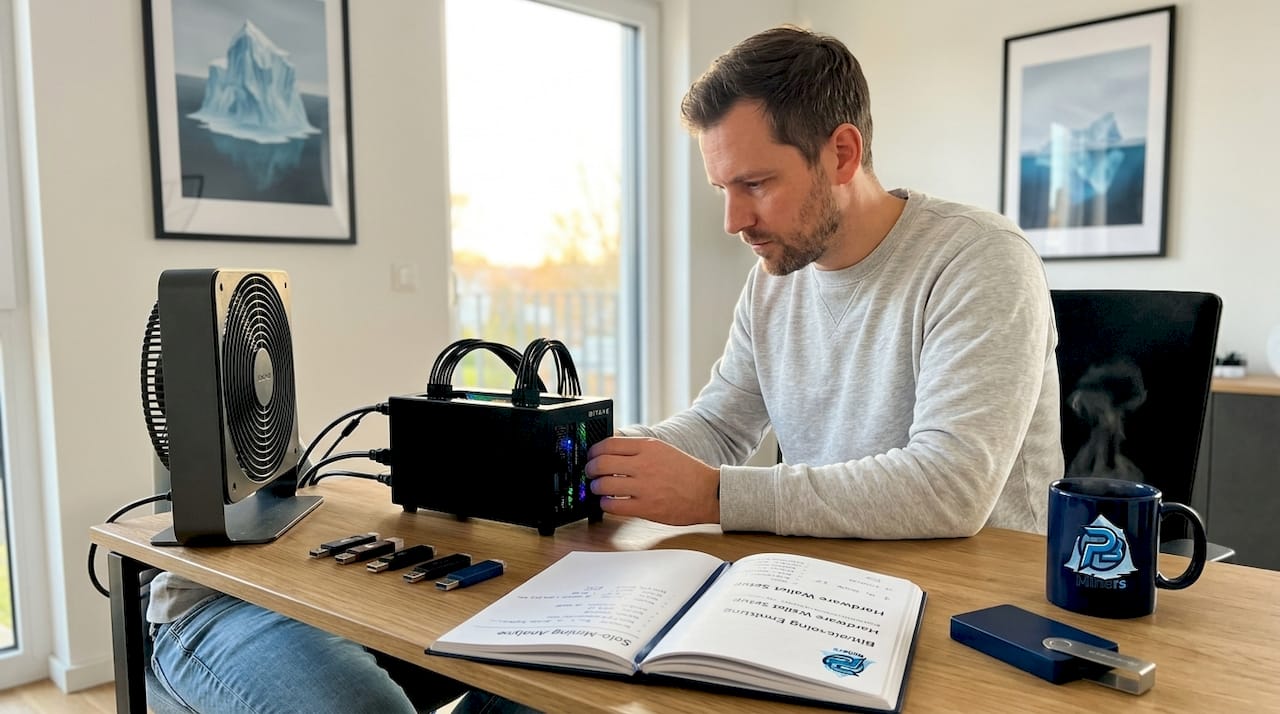
Proprietary mining software has trapped home users in an invisible snare for years: black-box algorithms, hidden pool fees, and dependencies on centralized providers. Open-source mining is fundamentally liberating the market in 2026. Through open systems (like MiningOS) and silent 15-watt desktop hardware, users gain full hardware sovereignty. It transforms mining into an eternal lottery ticket that participates in the draw completely autonomously 52,560 times a year. Whoever hits the jackpot of approximately 300,000 Euros keeps 100% of the reward—with no middlemen, directly to their own wallet.
Anyone seriously involved with Bitcoin quickly encounters a central paradox: a decentralized monetary system is increasingly dominated by highly centralized, proprietary software companies. For the home user, this often means expensive licenses and the gradual loss of control. But in 2026, there's a rebellion in the home office. Open-source mining enables the true, physical reclamation of the blockchain. It's no longer an abstract IT construct, but crypto you can touch.
What does Open Source Mining mean for home users in 2026?
Proprietary systems work like a locked leased car: you can drive it, but as soon as you want to look under the hood or swap parts, vendor lock-in takes effect. The result is hidden fees and mining pools that profit from your computing power.
Open-source mining gives you the keys to the workshop back. The firmware's source code is publicly viewable, free, and invulnerably transparent. For the end customer, this means:
- Full Control: Nobody can lock you out or retroactively charge licensing fees for your autonomous worker.
- No Middlemen: Open-source protocols like goPool allow you to run your miner autonomously. You pay exactly 0% fees to third parties.
- The Anti-Drawer Gift: It's not a boring DIY kit, but a premium technology highlight that is continuously improved by the global community thanks to open standards.
Why do open systems like MiningOS outperform outdated industrial software?
The technical dominance of open networks is impressively demonstrated by frameworks like Tether's MiningOS or the Mining Development Kit (MDK). Developed under the free Apache 2.0 license, they consolidate monitoring, power management, and hashrate in a transparent dashboard.
A massive advantage is seen in energy integration. While closed industrial plants require expensive electricity contracts, open-source software can be seamlessly linked with home solar systems. According to data from Fraunhofer ISE, massive amounts of uncompensated PV surpluses are wasted in German grids at midday. Your autonomous 15-watt miner precisely captures this electricity. A closed system from China simply does not allow such precise, local adaptations.
"Hardware is the new gold. But only an open infrastructure guarantees that nobody will pick your pocket. Those who use proprietary software are tenants. Those who practice open-source mining are owners of their own, autonomous crypto bank."
— Polarblock Lead Engineer
How does the principle of the eternal €300,000 lottery ticket work in practice?
Let's let the hard math speak. Solo mining is statistically extremely unlikely when compared to industrial data centers. But as a private user, you have to look at it from the perspective of expected value: it is the most lucrative form of lottery ever invented.
A lottery ticket burns money every week and ends up in the trash on Saturday. Your open-source crypto gadget, however, is an eternal ticket. With an extremely economical consumption of 15 watts, continuous operation effectively costs you only ~10 Euros in electricity per year. For that, the device participates in the draw completely automatically 144 times a day. This amounts to 52,560 chances per year to win the current jackpot of 3.125 BTC (equivalent to ~300,000 Euros). And thanks to the open-source setup, you share this win with absolutely no one.
The end of pool fees.
Forget black-box systems that take a cut from your hash rate. Calculate now how affordable your personal entry ticket to the decentralized network is.
Calculate your chances ➔Which system offers private users the highest hardware sovereignty?
Anyone who opts for mining faces the system question. Closed networks pose massive risks. Regulatory warnings from BaFin regularly refer to the risks of failure for centralized crypto custodians. What applies to exchanges also applies to opaque cloud mining pools: whoever controls the infrastructure controls your money.
The consequence is clear: open-source hardware is the only guaranteed way to avoid the crypto trauma of closed ecosystems.
How do you start most easily with your autonomous Plug & Forget worker?
The days of smoking server racks and Linux command lines are over. Starting your journey to financial sovereignty requires exactly three steps:
- Set up: Connect the Bitaxe Home Solo Miner normally to a power outlet via USB-C.
- Connect: Select the device's small configuration network via your smartphone.
- Start Autopilot: Enter your Wi-Fi password and Bitcoin receiving address. Save. That's it. The device will then operate completely silently and autonomously in the background.
Why is decentralization the only way to true passive income?
When 70 percent of global computing power runs through three large pool providers, the system is vulnerable. According to the Federal Environment Agency and energy economists, large industrial plants overwhelm the local power grid. A decentralized 15-watt worker on your desk, however, relieves networks and democratizes access to capital.
Every device in a German living room takes away a piece of power from monopolists. Open-source mining is therefore not just a technology decision. It is the conscious choice to generate passive income free from censorship and external control.
What questions do beginners ask about open solo mining in 2026?
What does open-source mining mean for private users in 2026?
It eliminates black-box algorithms and hidden pool fees. Users gain full hardware sovereignty and 100% of the block reward, completely free from reliance on central servers.
What are the real chances of winning with autonomous mining?
The device participates in the network's lottery 144 times a day. This results in a precisely calculated 52,560 chances per year to win a tax-free jackpot of currently around 300,000 Euros—an eternal lottery ticket.
Why is a 15-watt device better than industrial miners?
Industrial machines generate over 75 decibels of noise and unbearable electricity costs. An open 15-watt gadget for the desktop effectively costs only ~10 Euros in electricity per year and is absolutely suitable for living rooms thanks to Plug & Forget.
How does Open Source support sustainable crypto mining?
Due to its open architecture, tools like MiningOS can be directly linked with home solar systems. The miner automatically captures surplus PV energy without the need to sign expensive special contracts.
The Polarblocks Manufactory
We believe that access to the blockchain must be free, transparent, and physically tangible. In our Bavarian manufactory, we combine open-source firmware with highly aesthetic 15-watt desktop hardware. Crypto you can touch, safe from exchange failures, and with full hardware sovereignty.
Where can you find further reading on hardware sovereignty?
- Why this crypto gadget is the ultimate gift for tech-savvy men
- The easiest crypto entry: Why nobody needs deep IT knowledge anymore
- The FTX Shock: Why physical crypto is safer than any online exchange
- How the silent worker in the background operates with extreme energy efficiency


